
What is the main difference between Villora and psyllium powder?
The main difference is that Villora is a small multi-ingredient capsule, while psyllium powder is a larger dose of one fiber that you mix into a drink. The Villora panel lists a 695 mg proprietary blend of oat bran, flax seed, psyllium husk, apple pectin, konjac root, black walnut hull, plum and Lactobacillus acidophilus.1 A plain psyllium powder usually lists one item: psyllium husk.
Psyllium is third on Villora's list, so it is only part of the 695 mg. A scoop of plain powder is typically several grams, which is many times the weight of the whole Villora blend. Check the label of any powder you are weighing up, because serving sizes vary from product to product.
| Feature | Villora capsule | Plain psyllium powder (typical) |
|---|---|---|
| Form | 1 capsule, swallowed | Powder stirred into liquid |
| Ingredients | 8 items in one blend | Usually psyllium husk only |
| Weight per serving | 695 mg, whole blend | Grams per scoop, see its label |
| Fiber amount stated | Not stated on panel | Usually stated in grams |
| Probiotic | 1.5 billion CFU L. acidophilus | Usually none |
| Tree nuts | Contains walnut | Check its label |
| Texture | "No scoops · no grit" | Can thicken and feel gritty |
How much fiber do you get from each?
A scoop of plain psyllium powder almost always gives more fiber than one Villora capsule, because the entire Villora blend weighs 695 mg and not all of that is fiber.1 The panel does not state a fiber figure in grams, and it does not give the share of psyllium inside the blend.
The Dietary Guidelines for Americans set a goal of about 14 g of fiber per 1,000 calories.2 For a 2,000-calorie day, that is about 28 g. The whole Villora blend is about 2.5% of that, before you subtract the non-fiber parts. A powder serving of a few grams covers a larger share.
- Villora: 695 mg total blend, fiber grams not stated, psyllium share not stated.
- Plain powder: a single fiber, with grams per scoop printed on its own label.
- Food: fruits, vegetables, beans and whole grains supply most fiber for most people.3
This is not a knock on capsules. It is just the math of size. If your goal is to add a meaningful number of fiber grams, food comes first, and a powder generally carries more per serving than a single small capsule. Our Villora results page explains what a capsule can and cannot add.
Which costs less per day?
Villora costs between about $1.63 and $2.47 a day depending on the pack, based on the sales page.4 Plain psyllium powders vary widely in price, so the fair test is to divide the price of a tub by its number of servings and compare that daily figure.
| Villora pack | Per bottle | Total | Cost per day | Shipping |
|---|---|---|---|---|
| 2 bottles (60 days) | $69 | $138 | $2.30 ($2.47 with shipping) | $9.99 |
| 4 bottles (120 days) | $59 | $236 | about $1.97 | Free (US) |
| 6 bottles (180 days) | $49 | $294 | about $1.63 | Free (US) |
Then compare cost per gram of fiber, not just cost per day. A powder that costs less per serving and gives several grams will usually win on that measure. Villora's case rests on the capsule format and the mix of items, not on fiber per dollar. Prices can change, so check the live checkout before ordering. For a deeper value view, see is Villora worth it.
Which is more convenient to take?
Villora is more convenient for people who dislike mixing drinks, because it is one capsule a day with a glass of water. The front label says "1 Capsule Daily" and "No scoops · no grit · just swallow."1
- Capsule: no measuring, no stirring, easy to travel with.
- Capsule: one fixed amount, so you cannot adjust the dose in small steps.
- Powder: you can start with a partial scoop and build up slowly.
- Powder: needs a glass, a spoon and drinking it before it thickens.
- Both: need a full glass of water each time.
MedlinePlus advises adding fiber gradually and drinking plenty of fluids to limit gas and bloating.5 A powder makes slow steps easy. With a one-capsule product, the step is fixed. See how to take Villora for the label directions and the breakfast routine the sales page suggests.
Fiber gap meter
How much of a day's fiber goal can one capsule cover? The goal uses the Dietary Guidelines figure of 14 g per 1,000 calories.
Do both need the same water and safety rules?
Yes, both need plenty of water, because psyllium is a gel-forming fiber that swells when it meets liquid. Villora also contains konjac and pectin, which are gel-forming too.1 U.S. rules require a choking warning on over-the-counter drug products made with water-soluble gums such as psyllium and glucomannan.6
Take either product with a full glass of water. Stop and get urgent help for chest pain, vomiting, or trouble swallowing or breathing after taking it.
There is one clear difference. Villora contains black walnut hull, and the sales page says it contains tree nuts. Anyone with a tree-nut or walnut allergy should not take it. A plain psyllium powder may avoid that issue, but always read its own label.7
For both types, ask a doctor or pharmacist first if you are pregnant or nursing, take medicines, have trouble swallowing, a past bowel blockage or narrowing, or a digestive condition. Fiber can change how some medicines are absorbed, so ask about spacing. Our Villora and medications page has a list of questions to bring.
How do you compare any fiber product label?
Compare labels by reading the same five lines on each one: serving size, fiber grams, ingredient list, allergen statement and price per serving. The FDA's labeling guide explains that a Supplement Facts panel must show the serving size and the listed ingredients, and that a proprietary blend may show only its total weight.8
- Find the serving size: one capsule, one scoop, or more.
- Look for fiber in grams. If no grams are listed, note that you cannot compare fiber directly.
- Read every ingredient, including anything after the main fiber.
- Check for allergens such as tree nuts. Villora lists black walnut hull.1
- Divide the total price by the number of servings to get the cost per day.
This short routine works for any capsule or powder and keeps the decision grounded in what the labels actually say, rather than in what the ads suggest.
Who might prefer a capsule, and who might prefer powder?
A capsule suits people who value a simple fixed routine over a larger fiber dose, while powder suits people who want more fiber grams and fine control. Neither is a medical choice, and food should still carry most of your fiber.9
A one-capsule blend may suit you if
- You will not keep up with mixing a drink every day.
- You like the idea of several fiber types plus a probiotic in one place.
- You have no tree-nut allergy and no reason to avoid black walnut.
A plain powder may suit you if
- You want to see the fiber grams printed on the label.
- You want to build up slowly, a little at a time.
- You want to avoid tree nuts or keep your supplement to one ingredient.
- You want the lowest cost per gram of fiber.
If you are still choosing, our who should take Villora page lists fit and not-fit groups.
What does neither product tell you?
Neither label promises a specific result, and we saw no studies on the finished Villora product. Dietary supplements do not need FDA approval for effectiveness before they are sold.10
Villora's label also leaves some questions open: per-item milligrams are hidden in the blend, and the probiotic strain code is a placeholder.1 A single-fiber powder is simpler to read, but its own claims still deserve the same careful look. Persistent bowel changes are a reason to see a clinician, not to keep switching products.
If you decide the capsule format fits your routine, you can check the current Villora offer and confirm the pack prices on the live checkout. You can also read the whole panel on our Villora ingredients page first.
Ready to order? Compare the three Villora packs
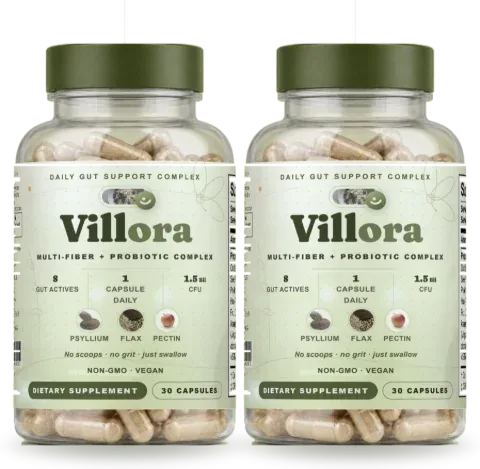
2 bottles
$69per bottle
- $138 total · 60 capsules
- $9.99 shipping
- $2.47 a day with shipping
- Good for trying the routine first
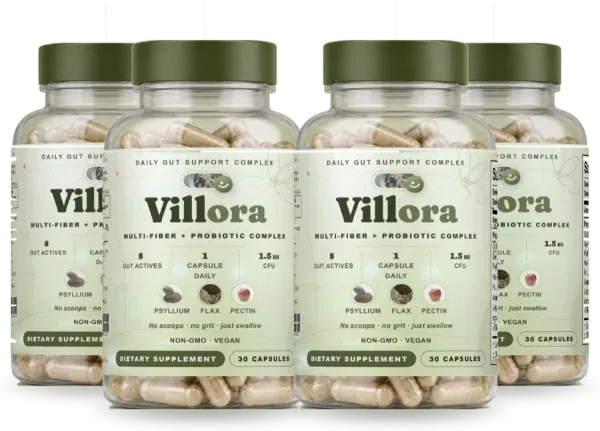
4 bottles
$59per bottle
- $236 total · 120 capsules
- Free US shipping
- about $1.97 a day
- Two digital guides included (sales page)
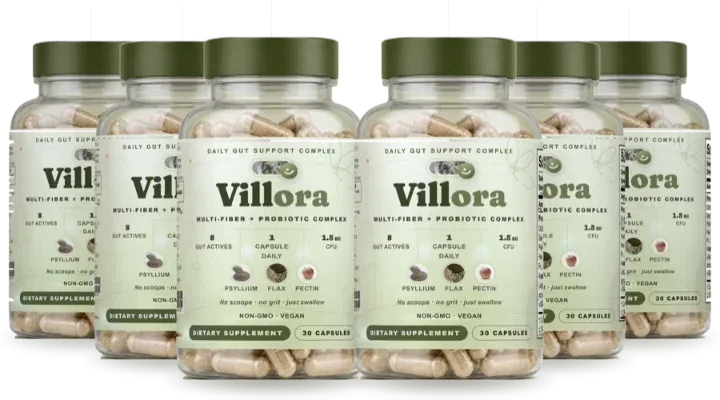
6 bottles
$49per bottle
- $294 total · 180 capsules
- Free US shipping
- about $1.63 a day
- Two digital guides included (sales page)

60-day money-back guarantee from the purchase date, per the sales page. Return the bottles, even empty, with tracking. Buyer pays return shipping. Questions: +1 (302) 200-3480 or [email protected].

Order links go to the official checkout through our checkout guide rules: check the address bar, the total and the shipping line before you pay. Tree-nut allergy? Do not order: the blend lists black walnut hull.
Questions people ask
Does one Villora capsule equal a scoop of psyllium powder?
No. The entire Villora blend weighs 695 mg, and psyllium is only one of eight items in it.1 A typical scoop of plain powder is several grams of psyllium, so the amounts are not comparable.
Is Villora cheaper per day than a tub of fiber powder?
It depends on the powder. Villora runs from about $1.63 to $2.47 a day by pack.4 Divide a powder's price by its servings, and also compare the fiber grams per serving, to see which costs less for what you get.
Do I still need a full glass of water with a fiber capsule instead of powder?
Yes. Psyllium, konjac and pectin swell with liquid, so a capsule needs a full glass of water just like a powder does. US rules require a choking warning on certain products with water-soluble gums.6
Can I switch from psyllium powder to Villora?
Talk to your doctor or pharmacist first, especially if you take medicines or have a digestive condition. Keep in mind one capsule likely gives far less fiber than your current scoop. People with a walnut or tree-nut allergy should not take Villora.
Why does Villora not list fiber grams like a powder label does?
Villora uses a proprietary blend, which shows only the 695 mg total and not each item's amount.1 The panel does not include a separate fiber line. A single-fiber powder usually prints its fiber grams per serving.
Sources for this page
- Villora bottle front label and Supplement Facts panel (photographed on this site)
- Dietary Guidelines for Americans
- MedlinePlus — High-fiber foods
- Villora official sales page, read 23 November 2026 (prices, shipping and guarantee terms)
- MedlinePlus — Dietary Fiber
- FDA eCFR 21 CFR 201.319 — water-soluble gums warning
- FDA — Food Allergies
- FDA — Dietary Supplement Labeling Guide
- Harvard T.H. Chan School of Public Health — The Nutrition Source: Fiber
- FDA — Dietary Supplements