
Does Villora work?
We cannot say that Villora works, because we found no published studies on the finished product. The label describes it as a "Daily Gut Support Complex" and lists a blend of seven fiber and plant powders plus one probiotic, but it does not claim a measured result.1
Research exists on fiber and on probiotics in general. That research does not transfer neatly to Villora. The blend hides how much of each item is in a capsule, and the probiotic strain code is a placeholder rather than a real code.1 Without amounts or a strain, there is no way to match the product to a specific study.
Dietary supplements do not need FDA approval for effectiveness before they are sold.2 That is normal for this category, and it is why we keep our language plain: Villora is sold as daily gut support, and its effect on any one person is unknown. For the ingredient side of the story, see how does Villora work.
What can one capsule realistically add?
One capsule adds a small amount of mixed fiber and a probiotic count of 1.5 billion CFU at manufacture.1 The entire blend weighs 695 mg, and that is the weight of all eight items together, not 695 mg of fiber.
| Measure | Amount | Note |
|---|---|---|
| Villora blend per capsule | 695 mg (0.695 g) | All 8 items, not all fiber |
| Fiber goal per 1,000 calories | about 14 g | Dietary Guidelines3 |
| Fiber goal on a 2,000-calorie day | about 28 g | 14 g x 2 |
| Whole blend as share of 28 g | about 2.5% | Upper limit; real fiber share is lower |
| Probiotic | 1.5 billion CFU | Counted at manufacture |
The numbers show the honest scale. A capsule cannot close a large fiber gap on its own. Fruit, vegetables, beans and whole grains supply most fiber for most people, and adding them slowly with enough fluid is the approach health agencies describe.4 If your diet is already low in fiber, food changes will move the number far more than any single capsule.
That does not make the capsule pointless for everyone. Some people simply want a fixed daily habit in capsule form, with no scoops or mixing. If that is your reason, be clear with yourself that you are paying for convenience and a mix of items, not for a large dose. Our is Villora worth it page weighs that trade-off against cost per day.
Why don't we give timelines?
We give no timelines because there is no evidence on the finished product to base one on. Any statement that Villora works within a set number of days would be a guess, and it would set expectations the label does not support.
- No studies on the finished Villora product were seen.
- Per-ingredient amounts are not disclosed.1
- The probiotic strain is not identified.
- People differ in diet, fluids, activity, medicines and health conditions.
- Digestive patterns change from week to week for many reasons unrelated to a supplement.
If you see a specific timeline in an ad or on another site, read it with caution. ODS notes that the effects of probiotics can vary by strain and by person, and that much is still unknown.5 That uncertainty applies even more to a blend with hidden amounts.
What about before-and-after stories?
Before-and-after stories are not evidence that a product works. They are individual accounts, often chosen for marketing, and they cannot show what would have happened without the product.
We do not publish testimonials from ads, packs or third parties. The three reader review cards on this site are individual experiences from the site owner’s records, not proof of any result. The most reliable information is the label and general research. The FDA advises consumers to be wary of supplement claims that sound too good to be true.2
- Stories cannot separate the product from diet or routine changes made at the same time.
- Ads select the most favorable accounts.
- Photos and quotes in ads may be dramatized.
- Your own steady, written record is more useful to you than anyone else's story.
For a guide to reading reviews and ad testimonials, see Villora customer reviews.
Fiber gap meter
How much of a day's fiber goal can one capsule cover? The goal uses the Dietary Guidelines figure of 14 g per 1,000 calories.
How can you keep a simple routine log?
Keep a short daily log with the same few entries each day, so you can see your own pattern and share it with a clinician if needed. It takes about a minute and is more useful than memory.
| Date | Capsule taken? | Glass of water? | Meals and fiber foods | Fluids | How you felt | Notes |
|---|---|---|---|---|---|---|
| Day 1 | Yes / No | Yes / No | e.g. oats, apple, beans | Approx. glasses | Brief words | Any gas, bloating, other |
| Day 2 | Yes / No | Yes / No | ||||
| Day 3 | Yes / No | Yes / No |
- Take the capsule at the same time each day, with breakfast or another meal you never skip, as the sales page suggests. Follow the label.
- Write down whether you had a full glass of water with it.
- Note your main fiber foods and roughly how much you drank that day.
- Record how you felt in a few plain words, plus any gas or bloating.
- Change one thing at a time, so the log stays readable.
Fiber and probiotics can cause temporary gas, bloating or stomach discomfort, especially at first. Note these honestly. If you also change your diet, the log helps you see which change matters. Our how to take Villora page covers the daily routine.
When should you talk to a clinician instead?
Talk to a clinician about any digestive symptom that persists, worsens or worries you, rather than waiting to see whether a supplement makes a difference. A supplement is not a way to manage an ongoing health problem.
- Bowel changes that last or keep coming back.
- Blood in the stool, black stool, or ongoing stomach pain.
- Unexplained changes in body weight or appetite.
- Vomiting, fever, or trouble swallowing.
- Any symptom that started after a new medicine.
Stop and get urgent help for chest pain, vomiting, or trouble swallowing or breathing after taking a fiber capsule. U.S. rules require a choking warning on certain over-the-counter drug products made with water-soluble gums such as psyllium and glucomannan.6
NIDDK suggests that people with constipation discuss diet changes and fiber with a health care professional.7 Bring your routine log. It gives your clinician a clear record of what you took, what you ate and how you felt.
Who should not use Villora at all?
Anyone with a walnut or tree-nut allergy should not take Villora, because black walnut hull is on the panel and the sales page says it contains tree nuts.1 Results do not matter if a product is not safe for you.
- Walnut or tree-nut allergy: do not take it.
- Under 18: the product is for adults.
- Pregnant or nursing: ask a doctor first.
- Taking any medicine: ask a pharmacist about spacing, since fiber can change how some medicines are absorbed.
- Trouble swallowing, a past bowel blockage or narrowing, or a digestive condition: ask first.
- Weakened immune system or serious illness: ask first.8
Report any serious reaction to the FDA through MedWatch.9 Read more on is Villora safe.
What if Villora does not suit you?
If Villora does not suit your routine, stop taking it and use the 60-day guarantee described on the sales page. You contact the seller with your order ID and return the bottles, even empty ones, with tracking.10
Refunds of the purchase price are processed within 3–5 business days after the return is received, and your card issuer may take another 5–10 business days to show it.10 The buyer pays return shipping. Full steps are on our Villora money back guarantee page.
If you want to try it with modest expectations, start with the label directions and your log. You can check the current Villora offer on the live checkout, where prices are confirmed.
Ready to order? Compare the three Villora packs
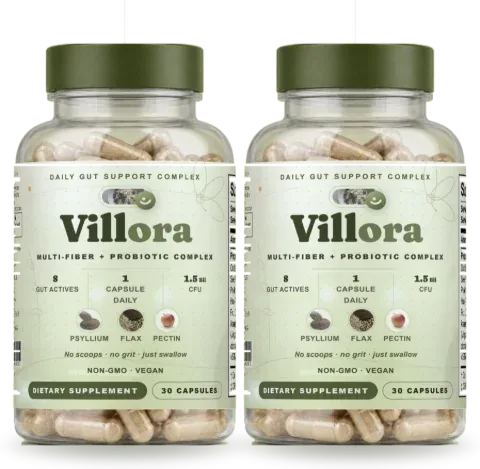
2 bottles
$69per bottle
- $138 total · 60 capsules
- $9.99 shipping
- $2.47 a day with shipping
- Good for trying the routine first
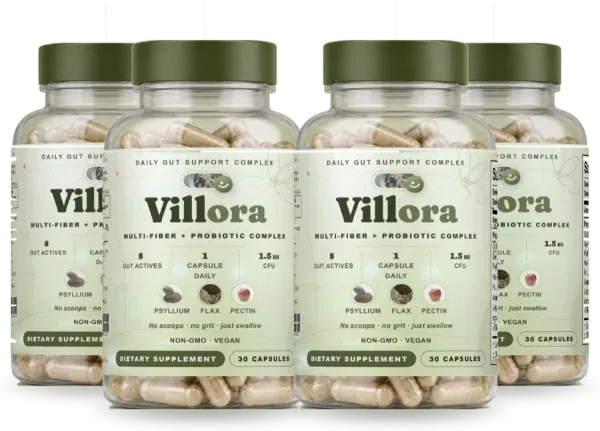
4 bottles
$59per bottle
- $236 total · 120 capsules
- Free US shipping
- about $1.97 a day
- Two digital guides included (sales page)
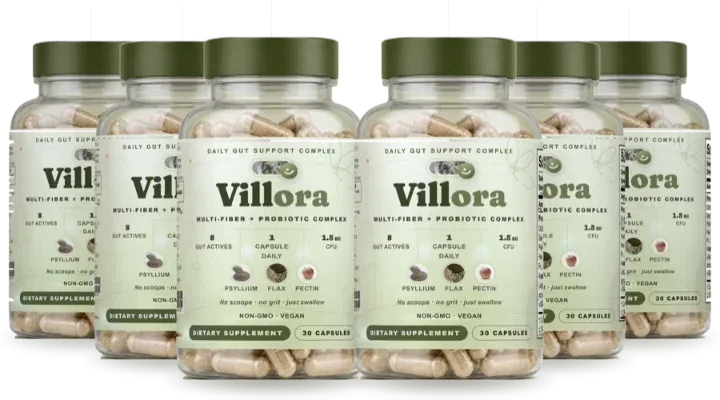
6 bottles
$49per bottle
- $294 total · 180 capsules
- Free US shipping
- about $1.63 a day
- Two digital guides included (sales page)

60-day money-back guarantee from the purchase date, per the sales page. Return the bottles, even empty, with tracking. Buyer pays return shipping. Questions: +1 (302) 200-3480 or [email protected].

Order links go to the official checkout through our checkout guide rules: check the address bar, the total and the shipping line before you pay. Tree-nut allergy? Do not order: the blend lists black walnut hull.
Questions people ask
Are there clinical studies on Villora itself?
We did not see any studies on the finished Villora product. Research exists on fiber and probiotics in general, but the hidden amounts and missing strain code make it hard to apply.1 We describe it only as sold for daily gut support.
How long should I take Villora before deciding if it suits me?
We do not give a timeline, because there is no product evidence to support one. Keep a simple daily log and discuss it with your clinician. The sales page describes a 60-day guarantee from purchase if you decide to stop.10
Is one Villora capsule enough fiber for the day?
No. The whole blend is 695 mg, while the daily goal is about 14 g per 1,000 calories, or about 28 g at 2,000 calories.3 Food remains the main fiber source.
Why do Villora ads show before-and-after stories?
Ads use stories because they are memorable. They are not evidence and cannot show cause and effect. The FDA advises caution with supplement claims that sound too good to be true.2
What should I write in a Villora routine log?
Note the date, whether you took the capsule with a full glass of water, your main fiber foods, fluids and how you felt. Keep it short and the same each day. Share it with your clinician if symptoms persist.
Sources for this page
- Villora bottle front label and Supplement Facts panel (photographed on this site)
- FDA — Information for Consumers on Using Dietary Supplements
- Dietary Guidelines for Americans
- MedlinePlus — Dietary Fiber
- NIH Office of Dietary Supplements — Probiotics fact sheet
- FDA eCFR 21 CFR 201.319 — water-soluble gums warning
- NIDDK — Eating, Diet & Nutrition for Constipation
- NCCIH — Probiotics: What You Need To Know
- FDA — MedWatch adverse event reporting
- Villora official sales page, read 23 November 2026 (prices, shipping and guarantee terms)