
Can you take Villora with medicine?
Many people can, but only after a pharmacist or doctor has looked at their medicine list. Villora is mostly fiber, and fiber can change how some medicines are absorbed. The timing that is safe for one medicine may not be right for another.
The label lists seven plant powders and one probiotic in a 695 mg proprietary blend, taken as one capsule daily with a meal and a full glass of water.12 Your pharmacist needs that information to give you a useful answer. The FDA encourages people to tell their health care providers about every supplement they use.3
Do not stop or change any prescribed medicine to make room for Villora. If timing is a problem, the supplement is the part to move or drop, and only your prescriber should change your medicine.
Why fiber can affect how medicines are absorbed
Fiber can affect absorption because some fibers form a gel in the gut and change how fast things move through it. Psyllium, konjac and apple pectin are gel-forming fibers on the Villora label.1 A medicine taken at the same moment may meet that gel rather than an empty stomach.
How much this matters varies a great deal. For some medicines it may make little difference; for others the timing can matter more. A pharmacist knows which of your medicines are sensitive to food and fiber, and can tell you how far apart to take them. They can also tell you whether a medicine should be taken with food, on an empty stomach, or at a set time, all of which affect where a breakfast capsule fits.
MedlinePlus explains that fiber comes in soluble and insoluble forms, and soluble fiber is the kind that dissolves in water to form a gel.45 Several of the Villora items are of that soluble type.
Why we do not give a set number of hours
We do not give a set number of hours because no single gap is right for every medicine. A fixed rule on a website could be too short for one medicine and needlessly long for another. Spacing is a question for your pharmacist, who can see your full list.
Your pharmacist may also tell you that a certain medicine should not be paired with a fiber supplement at all, or that you should talk to your prescriber first. That is a normal answer, not a sign that something is wrong. NCCIH advises people to talk with their health care providers before combining supplements and medicines.6
What to bring to the pharmacy counter
Bring the Villora bottle and a complete list of what you take. The pharmacist can then read the Supplement Facts panel directly rather than working from memory.
- The Villora bottle, or a clear photo of the Supplement Facts panel.1
- Every prescription medicine, with dose and time of day.
- Over-the-counter medicines you use, even occasionally.
- Other supplements: vitamins, minerals, herbs, fiber powders, other probiotics.
- Any allergies, especially to walnut or other tree nuts.
- Whether you are pregnant or nursing.
- Any trouble swallowing, bowel narrowing or digestive condition.
If you use one pharmacy for all your prescriptions, it may already have your list on file. Ask them to add Villora to your record so it shows up next time. Our how to take Villora page covers the daily routine once you have a plan.
Questions to ask your pharmacist
A short set of clear questions gets you a clear plan. These are the ones we suggest, and you can copy them onto a note or your phone before you go.
- Do any of my medicines need to be kept apart from a fiber supplement?
- If so, how far apart should I take them, and in which order?
- Is breakfast a good time for the capsule, given my medicine schedule?
- Are any of my medicines a concern alongside a probiotic?
- Does anything in this blend raise a concern with my health conditions?
- Should I check with my prescriber before starting?
- What signs should make me stop and call you or my doctor?
Write the answers down, or ask for them in print. A written schedule is easier to follow than one remembered from a busy counter. If you see more than one prescriber, share the same written schedule with each of them, so everyone is working from the same picture. Update it whenever a medicine is added, stopped or moved.
Planning a daily schedule
Once your pharmacist has given you the spacing, build your day around one fixed meal for the capsule. The sales page suggests breakfast or another meal you never skip, at about the same time each day.2
The table below is a blank planner, not advice. Fill in the times your pharmacist gives you.
| Item | Time of day | With food? | Pharmacist note |
|---|---|---|---|
| Villora, 1 capsule + full glass of water | Your chosen meal | Yes 2 | Spacing from medicines: |
| Medicine 1 | |||
| Medicine 2 | |||
| Other supplement |
If your pharmacist's advice means the capsule cannot sit at breakfast, the sales page wording allows any meal you never skip. Keep it at the same meal each day so the spacing stays the same.
Other supplements and the probiotic
Other supplements count as well, so tell your pharmacist about all of them. Doubling up on fiber products, or taking several probiotics, is worth a check even when no prescription is involved.
Villora contains Lactobacillus acidophilus at 1.5 billion CFU at the time of manufacture.1 NCCIH and the NIH Office of Dietary Supplements note that probiotics have a good safety record in healthy people, but that people with weakened immune systems or serious illness should talk to a doctor first.78 Medicines that affect the immune system are a good reason to ask before starting.
The probiotic line prints a placeholder instead of a strain code.1 That means your pharmacist cannot look up the exact strain. Our Villora label page explains that gap.
If you already started Villora without asking
If you have already started Villora and take a medicine, there is no need to panic, but do call or visit your pharmacist soon. Tell them when you started, what time you take the capsule and when you take each medicine.
Until you hear back, the cautious option is to pause the capsule rather than change anything about your medicine. A supplement can wait a few days; a prescribed medicine schedule usually should not move without advice.
- Keep taking your medicines exactly as prescribed.
- Pause Villora until you have spoken to the pharmacist.
- Note any changes you noticed since starting, even small ones.
- Mention the dates when you call, so the pharmacist can see the overlap.
- Restart only on the schedule they give you.
If you notice a change in how a medicine seems to work, such as symptoms it normally controls coming back, contact your prescriber. That applies whether or not a supplement is involved. NCCIH notes that some supplements can change how medicines work in the body, which is why it urges openness with all your providers.6
If the advice is to stop for good, you can contact the seller at +1 (302) 200-3480 or [email protected] with your order ID.2 Our Villora refund page explains the return steps.
Who should talk to a doctor, not just a pharmacist
Some people should speak with their doctor before taking Villora, even after a pharmacist has advised on timing. That includes anyone who is pregnant or nursing, has trouble swallowing, has had a bowel blockage or narrowing, has a digestive condition, or has a weakened immune system or serious illness.
Anyone with a walnut or tree-nut allergy should not take Villora at all; the sales page says it contains tree nuts (walnut).2 Some references advise avoiding black walnut preparations in pregnancy.9 For a fuller fit check, see who should take Villora.
If anything goes wrong after a dose, such as chest pain, vomiting, or trouble swallowing or breathing, stop and get urgent help. You can report problems with supplements to the FDA through MedWatch.10 Our Villora side effects page covers milder effects too.
Ready to order? Compare the three Villora packs

2 bottles
$69per bottle
- $138 total · 60 capsules
- $9.99 shipping
- $2.47 a day with shipping
- Good for trying the routine first

4 bottles
$59per bottle
- $236 total · 120 capsules
- Free US shipping
- about $1.97 a day
- Two digital guides included (sales page)
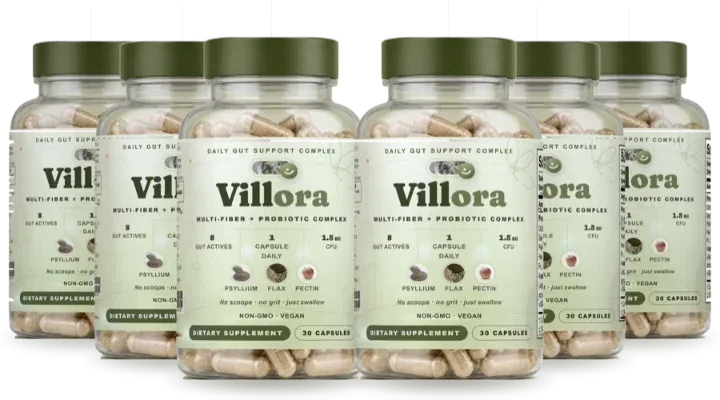
6 bottles
$49per bottle
- $294 total · 180 capsules
- Free US shipping
- about $1.63 a day
- Two digital guides included (sales page)

60-day money-back guarantee from the purchase date, per the sales page. Return the bottles, even empty, with tracking. Buyer pays return shipping. Questions: +1 (302) 200-3480 or [email protected].

Order links go to the official checkout through our checkout guide rules: check the address bar, the total and the shipping line before you pay. Tree-nut allergy? Do not order: the blend lists black walnut hull.
Questions people ask
Can I take Villora in the same swallow as my morning pills?
Ask your pharmacist before doing this. Fiber can change how some medicines are absorbed, so taking them together may not be right for every medicine. Your pharmacist can tell you whether to separate them and in what order.
Does Villora interact with birth control pills?
We cannot give a medicine-by-medicine answer, and the label does not list interactions. Ask your pharmacist about your specific product. Do not change how you take your birth control without professional advice.
Should I tell my doctor I started Villora?
Yes. The FDA and NCCIH both encourage people to tell their health care providers about every supplement they use. It helps your doctor make sense of any change in how you feel or how a medicine works.
Is a pharmacist visit free for a Villora timing question?
Many pharmacists answer supplement and timing questions at the counter without an appointment. Policies vary by pharmacy, so ask yours. Bring the bottle to keep the conversation short.
What if my pharmacist says not to take Villora?
Follow that advice. Your medicines come first. If you have already bought it, the sales page describes a 60-day money-back guarantee from purchase.
Sources for this page
- Villora bottle front label and Supplement Facts panel (photographed on this site)
- Villora official sales page, read 23 November 2026 (prices, shipping and guarantee terms)
- FDA — Information for Consumers on Using Dietary Supplements
- MedlinePlus — Dietary Fiber
- MedlinePlus — Fiber (encyclopedia)
- NCCIH — Using Dietary Supplements Wisely
- NCCIH — Probiotics: What You Need To Know
- NIH Office of Dietary Supplements — Probiotics fact sheet
- Drugs.com — Black walnut (natural product monograph)
- FDA — MedWatch adverse event reporting