
Is Villora safe to take?
For a healthy adult with no tree-nut allergy who follows the label, the ingredients in Villora are common food-type fibers and a well-known probiotic species.1 That is the honest short answer. The longer answer depends on who you are, what else you take, and how you take it.
We can only judge what the label shows. The panel lists eight items in a 695 mg proprietary blend, without the amount of each one.1 It also prints a placeholder, «STRAIN ID», where a probiotic strain code would normally go.1 Those gaps do not make a product unsafe, but they do limit how precise any safety review can be. Where we could not confirm something, we say so below rather than fill the gap with a guess. The rest of this page goes ingredient by ingredient, then group by group.
Three rules before any dose: no walnut or tree-nut allergy; a full glass of water with every capsule; ask a doctor or pharmacist first if you are pregnant, nursing, on medicines or have a digestive condition.
How dietary supplements are regulated
Dietary supplements are not approved by the FDA before they reach the market. The FDA explains that companies are responsible for making sure their products are safe and that label claims are truthful, and that the agency can act against unsafe products after they are sold.2
That means a supplement label is a company statement, not a government seal. Villora is labeled as a "Dietary Supplement".1 The FDA's labeling guide sets out what a Supplement Facts panel must show, including serving size and, for a proprietary blend, the total weight of the blend.3 Villora's panel gives that total, 695 mg, which fits the format.
We have seen no evidence of FDA approval for Villora, and supplements are not approved that way. Our is Villora legit page looks at the business side: contacts, guarantee and checkout.
Safety notes for each label item
Each of the eight label items has its own safety profile in general. The table below summarizes what the sources say about each type, in label order.1 It does not describe tested results from Villora.
| No. | Label item | General safety note |
|---|---|---|
| 1 | Oat bran powder | A common food fiber; adding fiber fast can cause gas 4 |
| 2 | Flax seed powder | NCCIH summarizes flaxseed research and advises taking it with plenty of water 5 |
| 3 | Psyllium husk powder | Gel-forming; choking warning applies to drug products 6 |
| 4 | Apple pectin powder | Gel-forming soluble fiber; take with water |
| 5 | Konjac root powder | Source of glucomannan; choking warning applies to drug products 6 |
| 6 | Black walnut hull powder | Tree-nut allergy risk; avoid in pregnancy per some references 7 |
| 7 | Plum powder | A fruit powder; amount not given on the panel |
| 8 | Lactobacillus acidophilus | Good safety record in healthy people; caution if immune system is weak 8 |
The pattern is clear. Most items are fibers you could find in a normal diet, two items are the swelling type that need water, one item is a walnut part, and one is a probiotic. More detail on each sits on our Villora ingredients page.
The fiber question: swelling and water
The main physical safety point is that psyllium, konjac and pectin swell when they meet liquid. Taken with too little water, a swelling fiber can lodge in the throat or chest. US rules require over-the-counter drug products made with water-soluble gums such as psyllium and glucomannan to carry a choking warning.6
Villora is a supplement, not one of those drug products, but the fiber does not know the difference. The sales page tells buyers to take the capsule with a meal and a full glass of water.9 We would add: stay upright, and do not take it just before lying down.
Fiber in general is part of a normal diet and is widely recommended.10 The Dietary Guidelines for Americans suggest 14 g per 1,000 calories.11 A 695 mg blend, which also holds the probiotic and walnut hull, is small next to that goal.1 So the fiber dose itself is modest; the risk is in how it is swallowed.
The probiotic question: who should be careful
Probiotics are generally considered safe for healthy people, with mild digestive effects such as gas being the most common.8 The concern is for a smaller group: people with weakened immune systems or serious illness, for whom rare but serious problems have been reported.812
Villora lists Lactobacillus acidophilus at 1.5 billion CFU, guaranteed at the time of manufacture.1 Because no strain code is printed, you cannot look up research on the exact strain. Our Villora vs probiotic capsules page explains why the strain matters when comparing products.
The walnut question: allergy and pregnancy
Black walnut hull is the ingredient that rules some people out entirely. The sales page says Villora contains tree nuts (walnut), so anyone with a walnut or tree-nut allergy should not take it.9 Tree nuts are among the major food allergens the FDA identifies.13
Cross-reactivity among tree nuts is possible, and some references advise avoiding black walnut preparations in pregnancy.7 FARE notes that tree-nut allergies are often lifelong and can cause severe reactions.14 If you have any nut allergy, talk to an allergist before trying it.
Villora warnings in one list
These are the Villora warnings we think every buyer should read before the first capsule. They come from the label, the sales page and the official sources above.
- Do not take it with a walnut or tree-nut allergy.9
- For adults 18 and over only.9
- Take one capsule daily, with a meal and a full glass of water; follow the label.19
- Stop and get urgent help for chest pain, vomiting, or trouble swallowing or breathing after taking it.
- Ask a doctor first if pregnant or nursing.
- Ask a pharmacist first if you take any medicine; fiber can change how some medicines are absorbed.
- Ask a doctor first with trouble swallowing, a past bowel blockage or narrowing, a digestive condition, a weakened immune system or a serious illness.
- Expect possible temporary gas, bloating or stomach discomfort, especially at first.
For the common effects and what to do about them, see Villora side effects. For medicine timing, see Villora and medications.
What we could not verify
There are several safety-related points we could not check from the label or sales page, and we think buyers should know them. Being clear about gaps is part of a fair safety review.
- Per-item amounts. The panel gives 695 mg for the whole blend, not for each item.1
- Strain code. The probiotic line shows a placeholder, not a strain ID.1
- Other ingredients. The label images we saw do not show an other-ingredients line or the capsule-shell material.
- Product studies. We saw no study on the finished Villora product.
- Testing claims. We saw no testing claim on the label, so we make none.
The front label does say Non-GMO and Vegan.1 Those are label statements, and we report them as such. Our Villora label page goes through the panel line by line if you want to check each point yourself.
NCCIH advises that natural does not always mean safe, and that people should talk to their health care providers before using supplements, especially alongside medicines.15 That advice applies here as much as to any product. A bottle in your hand at the pharmacy counter is the fastest way to get a personal answer.
What to do if something goes wrong
If you have a reaction, stop taking Villora first, then get help that matches how serious it is. Emergencies such as trouble breathing, swelling of the face or throat, or chest pain need emergency care right away.
For anything less urgent, call your doctor and bring the bottle. Then report it: the FDA's MedWatch program accepts reports of problems with dietary supplements directly from consumers.16 The FDA explains that these reports help it find safety problems once products are on the market.17
You can also tell the seller at +1 (302) 200-3480 or [email protected].9 If you no longer want the product, the sales page describes a 60-day money-back guarantee from purchase.9
Ready to order? Compare the three Villora packs
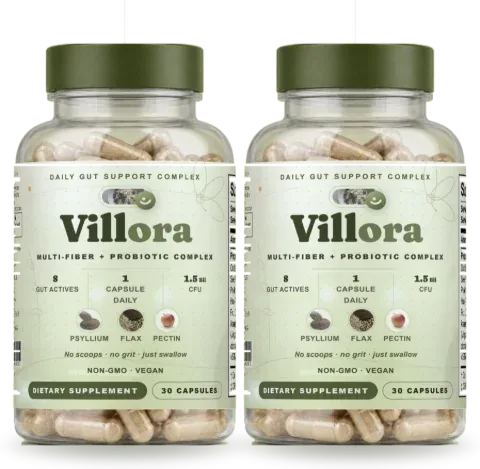
2 bottles
$69per bottle
- $138 total · 60 capsules
- $9.99 shipping
- $2.47 a day with shipping
- Good for trying the routine first
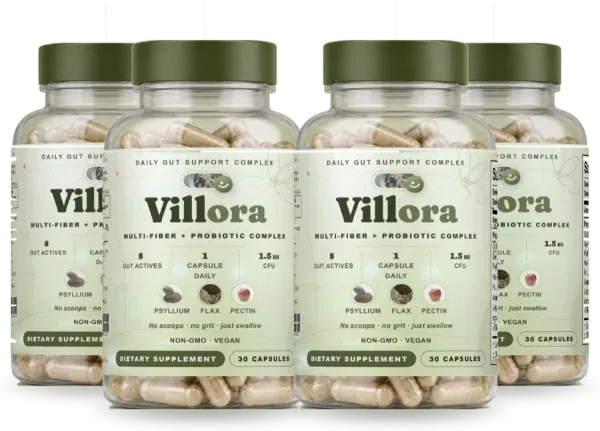
4 bottles
$59per bottle
- $236 total · 120 capsules
- Free US shipping
- about $1.97 a day
- Two digital guides included (sales page)
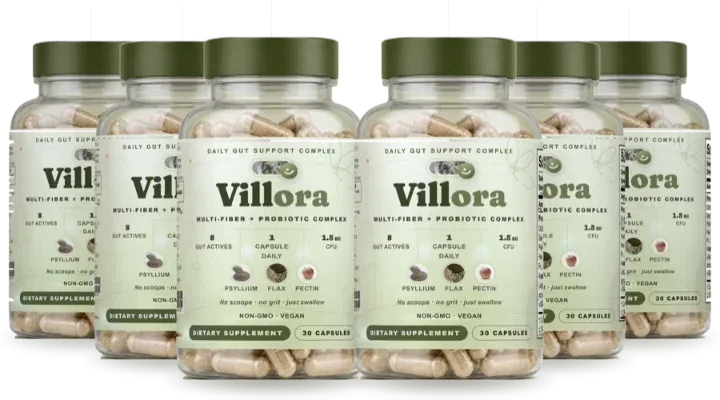
6 bottles
$49per bottle
- $294 total · 180 capsules
- Free US shipping
- about $1.63 a day
- Two digital guides included (sales page)
60-day money-back guarantee from the purchase date, per the sales page. Return the bottles, even empty, with tracking. Buyer pays return shipping. Questions: +1 (302) 200-3480 or [email protected].

Order links go to the official checkout through our checkout guide rules: check the address bar, the total and the shipping line before you pay. Tree-nut allergy? Do not order: the blend lists black walnut hull.
Questions people ask
Is Villora safe to take every day long term?
We cannot say, because no long-term study on the finished product was seen. The ingredients are common food-type fibers and a probiotic, but long-term use is a question for your doctor, especially if you have a health condition.
Does the missing strain ID make Villora unsafe?
Not by itself. It means you cannot look up research on the exact strain of Lactobacillus acidophilus used. People with weakened immune systems should ask a doctor before any probiotic, strain listed or not.
Has the FDA checked Villora for safety?
The FDA does not review dietary supplements for safety before they are sold. Companies are responsible for safety, and the FDA can act after a product is on the market. We have seen no FDA approval for Villora, and supplements are not approved that way.
Is Villora safer than a fiber powder?
Not necessarily. Both rely on swelling fibers that need plenty of water. A capsule avoids measuring a scoop, but the water rule and the allergy rule still apply.
Can I give Villora to my teenager?
No. The sales page says Villora is for adults 18 and over. Talk to a pediatrician about fiber from food for teens.
Sources for this page
- Villora bottle front label and Supplement Facts panel (photographed on this site)
- FDA — Dietary Supplements
- FDA — Dietary Supplement Labeling Guide
- MedlinePlus — Fiber (encyclopedia)
- NCCIH — Flaxseed and Flaxseed Oil
- FDA eCFR 21 CFR 201.319 — water-soluble gums warning
- Drugs.com — Black walnut (natural product monograph)
- NCCIH — Probiotics: What You Need To Know
- Villora official sales page, read 23 November 2026 (prices, shipping and guarantee terms)
- MedlinePlus — Dietary Fiber
- Dietary Guidelines for Americans
- NIH Office of Dietary Supplements — Probiotics fact sheet
- FDA — Food Allergies
- FARE — Tree nut allergy
- NCCIH — Using Dietary Supplements Wisely
- FDA — MedWatch adverse event reporting
- FDA — Information for Consumers on Using Dietary Supplements