
What does the Villora label actually claim?
The label claims very little about how Villora works. The front says "Daily Gut Support Complex," "Multi-Fiber + Probiotic Complex," "8 Gut Actives" and "1 Capsule Daily," and the panel lists a 695 mg proprietary blend.1 There is no mechanism described on the bottle.
| Front label phrase | What it describes |
|---|---|
| Daily Gut Support Complex | How the product is positioned |
| Multi-Fiber + Probiotic Complex | The two kinds of ingredients |
| 8 Gut Actives | Eight items in the blend |
| 1.5 Bil CFU | Probiotic count at manufacture |
| No scoops · no grit · just swallow | Capsule format |
| Non-GMO · Vegan | Maker's diet claims |
Words like "support" describe a general role, not a measured effect. Under U.S. rules, dietary supplements are not reviewed by the FDA for effectiveness before they are sold.2 So when we explain how Villora "works," we are really explaining what its ingredient types are and what is known about them in general.
What is dietary fiber, in general?
Dietary fiber is the part of plant foods that the body does not fully digest. MedlinePlus explains that fiber is found in fruits, vegetables, whole grains, nuts, seeds and beans, and that it passes through the digestive system mostly intact.3
Fiber is usually grouped into two types. Soluble fiber dissolves in water and forms a gel-like material. Insoluble fiber does not dissolve and adds bulk to stool.4 Most plant foods contain a mix of both.
- Soluble fiber: dissolves in water and forms a gel. Found in oats, beans, apples and psyllium.4
- Insoluble fiber: does not dissolve and adds bulk. Found in wheat bran, vegetables and whole grains.
- Fermentable fiber: some fibers are broken down by bacteria in the colon.5
- Daily goal: about 14 g per 1,000 calories in the Dietary Guidelines.6
The Harvard Nutrition Source notes that fiber from whole foods is part of a healthy diet and that most Americans eat less than the recommended amount.5 That is the backdrop for why fiber products exist. It is general nutrition, not a statement about Villora.
Which kinds of fiber are on the Villora label?
Villora's label lists several plant items that are known as fiber sources in food: oat bran, flax seed, psyllium husk, apple pectin and konjac root, followed by black walnut hull and plum powder.1 Psyllium, pectin and konjac are gel-forming fibers that swell with liquid.
| Label item (in order) | General fiber description |
|---|---|
| Oat bran | Outer layer of oats, a grain fiber source |
| Flax seed | Seed powder, a fiber source in food |
| Psyllium husk | Gel-forming, soluble fiber |
| Apple pectin | Gel-forming, soluble fiber from fruit |
| Konjac root | Source of glucomannan, a gel-forming fiber |
| Black walnut hull | Tree nut hull; not mainly a fiber source |
| Plum powder | Fruit powder |
The key limit is amount. The whole blend weighs 695 mg, and that weight includes non-fiber material and the probiotic.1 Compared with a daily goal near 28 g on a 2,000-calorie diet, one capsule is a very small share. Our Villora ingredients page covers each item one by one.
What are probiotics, in general?
Probiotics are live microorganisms intended to have health benefits when eaten or applied to the body. That is the definition NCCIH uses.7 They are found in some fermented foods and in dietary supplements.
The NIH Office of Dietary Supplements explains that probiotics are measured in colony-forming units (CFU) and identified by genus, species and strain.8 It also notes that effects can differ from strain to strain, and that a higher CFU count does not necessarily mean better effects.
Villora lists one probiotic: Lactobacillus acidophilus at 1.5 billion CFU, guaranteed at time of manufacture. The strain code on the panel is a placeholder, «STRAIN ID», so the specific strain is not identified.1 That makes it impossible to link the product to research on a particular strain. Read more on Villora Lactobacillus acidophilus.
- Probiotics are live organisms, so storage and age can affect counts.
- Research on probiotics in general is mixed and strain-specific.7
- Side effects are usually mild, such as gas.
- People with weakened immune systems should ask a doctor first.
Label or ad? Claim sorter
Tap where you think each claim comes from. The answer shows after each tap.
1.5 billion CFU of Lactobacillus acidophilus
Printed on the Supplement Facts panel, guaranteed at time of manufacture.
“Sweep, cleanse, repair”
Ad and sales-page story. The label makes no such claim, and we do not repeat it as a benefit.
Non-GMO and Vegan
Both words are printed on the front label.
Factory, registration and certification badges
Seen in ads and on look-alike pages, but not printed on the label we reviewed, so this site does not use them.
The milligrams of each fiber
Not shown anywhere we saw. The panel gives only the 695 mg blend total.
A strain code for the probiotic
The panel prints a placeholder («STRAIN ID») instead of a code.
Black walnut hull
Listed on the panel. The sales page adds a tree-nut (walnut) warning.
One capsule daily, 30 capsules
Front label and panel: serving size 1 capsule, 30 servings.
Where does "sweep, cleanse, repair" come from?
"Sweep, cleanse, repair" comes from Villora's advertising, not from the label. It is a marketing story that describes the product in three steps. It is not printed on the Supplement Facts panel, and it is not a claim we can support.
We mention it because many readers arrive here after seeing the ads. The story suggests the product moves through the gut doing three distinct jobs. Nothing on the bottle says that, and we saw no studies on the finished Villora product that test it.
| Step in "sweep, cleanse, repair" | Is it on the label? | What we can say instead |
|---|---|---|
| Step 1 | No | The label lists fiber sources; fiber adds bulk in general4 |
| Step 2 | No | No such claim on the label; we do not repeat it |
| Step 3 | No | No such claim on the label; no product studies seen |
We do not present any step of the "sweep, cleanse, repair" story as something Villora does. Read it as ad language. The label describes the product only as daily gut support with a multi-fiber and probiotic blend.
Why is the ad story not the same as a label claim?
A label claim is printed on the product and is subject to labeling rules, while ad copy is a sales message that can be looser. Every supplement label must carry a Supplement Facts panel listing the serving size and ingredients, and that panel is where the product facts on this site come from.1
The FDA also advises consumers to be cautious about supplement marketing and to talk with a health care provider before relying on a product's promises.2 Vivid three-step stories are memorable, which is why ads use them. Memorable is not the same as tested.
- Label: "Daily Gut Support Complex," ingredient list, CFU, serving size.
- Ads: "sweep, cleanse, repair," stories and imagery.
- Our approach: report the label, cite general research, and say plainly where proof is missing.
For a guide to spotting overreach in ads and sales pages, see is Villora legit.
What is known, and what is not?
What is known is the label and the general science on fiber and probiotics; what is not known is how this specific capsule performs. Keeping those two lists apart is the clearest way to think about how Villora works.
Known from the label and general sources
- The blend has eight items in a stated order and weighs 695 mg in total.1
- The probiotic is L. acidophilus at 1.5 billion CFU, counted at manufacture.1
- Fiber is a normal part of a healthy diet, and most people eat less than the goal.5
- Probiotic effects depend on the strain and are still being studied.7
Not known or not disclosed
- How many milligrams of each item are in a capsule.
- Which strain of L. acidophilus is used.
- How many live units remain at the end of shelf life.
- Whether the finished product has been studied in people.
When a supplement leaves this many gaps, the most useful thing a buyer can do is ask questions and keep expectations modest. NCCIH suggests talking with a health care provider before starting a probiotic, especially if you have health problems.7 Our Villora label page lists each gap alongside the line where it appears.
What does this mean for someone thinking about Villora?
It means you should view Villora as a small daily fiber and probiotic capsule, not as a product with a proven mechanism. The best-supported way to get more fiber is still food, raised slowly with plenty of fluid.3
If you still want to try it, follow the label: one capsule daily with breakfast, or another meal you never skip, and a full glass of water. The gel-forming fibers swell with liquid. Stop and get urgent help for chest pain, vomiting, or trouble swallowing or breathing.9
Do not take Villora if you have a walnut or tree-nut allergy, since black walnut hull is on the panel. Ask a doctor or pharmacist first if you are pregnant or nursing, take medicines, or have a digestive condition, trouble swallowing or a past bowel blockage. See how to take Villora and Villora results for honest expectations, or check the current Villora offer on the live checkout.
Ready to order? Compare the three Villora packs
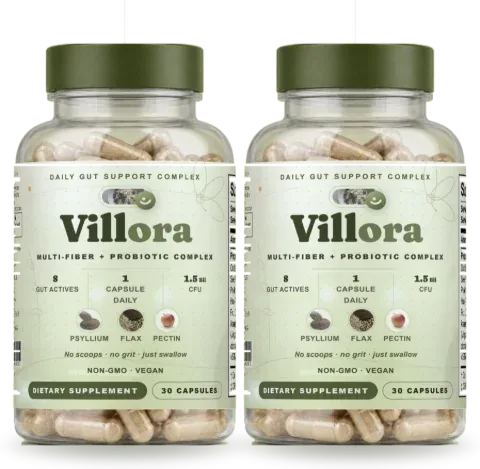
2 bottles
$69per bottle
- $138 total · 60 capsules
- $9.99 shipping
- $2.47 a day with shipping
- Good for trying the routine first
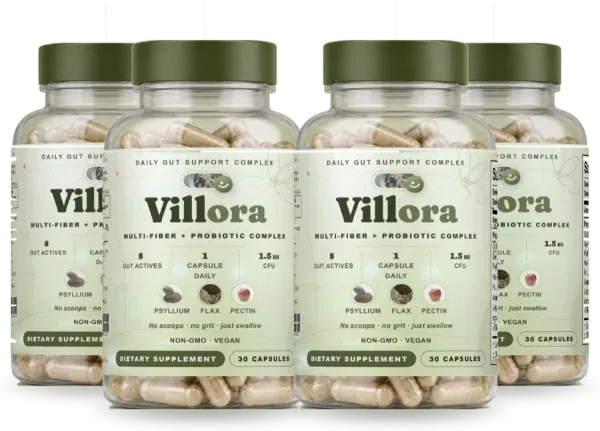
4 bottles
$59per bottle
- $236 total · 120 capsules
- Free US shipping
- about $1.97 a day
- Two digital guides included (sales page)
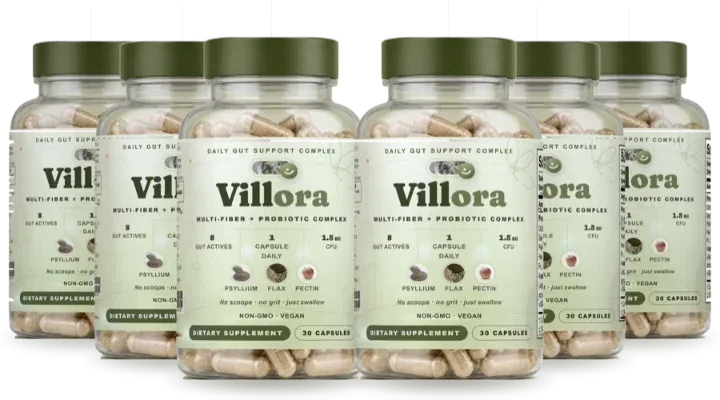
6 bottles
$49per bottle
- $294 total · 180 capsules
- Free US shipping
- about $1.63 a day
- Two digital guides included (sales page)
60-day money-back guarantee from the purchase date, per the sales page. Return the bottles, even empty, with tracking. Buyer pays return shipping. Questions: +1 (302) 200-3480 or [email protected].

Order links go to the official checkout through our checkout guide rules: check the address bar, the total and the shipping line before you pay. Tree-nut allergy? Do not order: the blend lists black walnut hull.
Questions people ask
Is "sweep, cleanse, repair" printed on the Villora bottle?
No. That three-step line comes from the ads, not the label.1 The bottle describes Villora as a "Daily Gut Support Complex" with a multi-fiber and probiotic blend.
Does Villora work like a fiber powder in capsule form?
In part. Villora contains several fiber sources, including psyllium, but the whole blend is only 695 mg.1 A fiber powder serving is usually several grams, so the amounts are very different.
How do the fiber and the probiotic in Villora interact?
The label does not say. In general, some fibers are fermented by gut bacteria, which is why fiber and probiotics are often discussed together.5 We saw no studies on how Villora's specific mix behaves.
Why does Villora call itself 8 Gut Actives?
The front label counts the eight items in the proprietary blend: seven plant powders and one probiotic.1 "Actives" is a label term, not a measure of effect.
Has anyone tested how Villora works in people?
We did not see any studies on the finished Villora product. Research exists on fiber and probiotics in general, but the hidden per-item amounts and missing strain ID make it hard to apply that research here.8
Sources for this page
- Villora bottle front label and Supplement Facts panel (photographed on this site)
- FDA — Information for Consumers on Using Dietary Supplements
- MedlinePlus — Dietary Fiber
- MedlinePlus — Fiber (encyclopedia)
- Harvard T.H. Chan School of Public Health — The Nutrition Source: Fiber
- Dietary Guidelines for Americans
- NCCIH — Probiotics: What You Need To Know
- NIH Office of Dietary Supplements — Probiotics fact sheet
- FDA eCFR 21 CFR 201.319 — water-soluble gums warning