
What is in Villora?
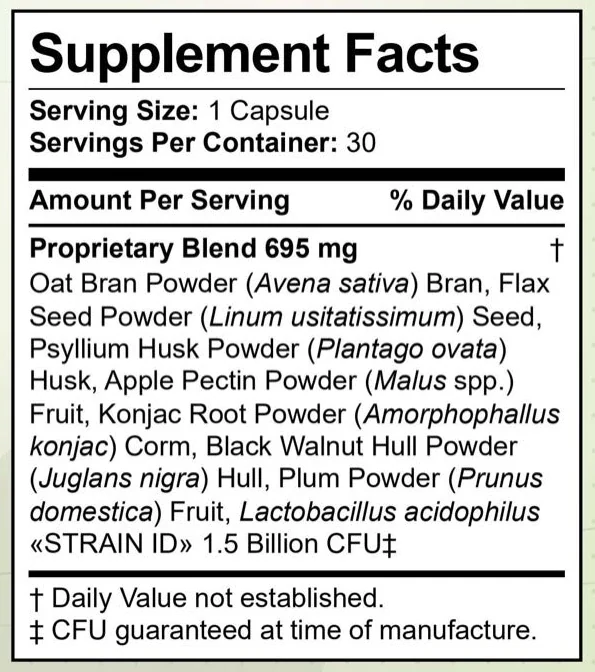
Villora contains seven plant powders and one probiotic, all grouped into a single proprietary blend of 695 mg per capsule.1 One capsule is one serving, and the bottle holds 30 servings. The front of the bottle calls it a "Daily Gut Support Complex" and a "Multi-Fiber + Probiotic Complex", and it counts "8 Gut Actives".
The eight items are not all fibers in the same sense. Some are classic soluble fibers that form a gel with water, such as psyllium, pectin and konjac. Some are whole-food powders that carry fiber along with other parts of the plant, such as oat bran, flax seed and plum. One is a botanical hull, black walnut, that is not usually eaten as a fiber food at all. And one is a live microorganism, the probiotic.
| Order | Ingredient as printed | Plant part or form | Our page |
|---|---|---|---|
| 1 | Oat Bran Powder (Avena sativa) | bran | Oat bran |
| 2 | Flax Seed Powder (Linum usitatissimum) | seed | Flax seed |
| 3 | Psyllium Husk Powder (Plantago ovata) | husk | Psyllium husk |
| 4 | Apple Pectin Powder (Malus spp.) | fruit | Apple pectin |
| 5 | Konjac Root Powder (Amorphophallus konjac) | corm | Konjac root |
| 6 | Black Walnut Hull Powder (Juglans nigra) | hull | Black walnut hull |
| 7 | Plum Powder (Prunus domestica) | fruit | Plum powder |
| 8 | Lactobacillus acidophilus | 1.5 billion CFU at time of manufacture | Probiotic |
Each item has its own page on this site. Start with psyllium husk or black walnut hull if those are the two you want to check first.
Why does the order on the label matter?
The order matters because FDA labeling rules require the ingredients inside a proprietary blend to be listed in descending order of predominance by weight.2 So oat bran is the item present in the largest amount by weight, and items lower on the list are present in equal or smaller amounts.
That is all the order tells you. It does not say how big the gaps are. Oat bran could be most of the blend, or it could be only slightly heavier than flax seed. The same goes for every step down the list. Two items next to each other could be nearly equal or very different.
The order also hints at something easy to miss. The front label shows psyllium, flax and pectin icons, yet oat bran sits at the top of the panel.1 Psyllium is third and pectin is fourth. The pictures on the front are design choices. The panel on the back is the part to read.
Label order is a ranking by weight, not a recipe. Nobody outside the maker can turn the order into milligrams for each item.
What blend math can we do with 695 mg?
Blend math gives only ceilings and floors, not amounts. Because the items are ranked by weight, the first item must be at least one-eighth of the blend, and the item in position number k can be no more than 695 mg divided by k. These are logical limits from the ranking rule, not estimates of what is really inside.
| Position | Item | What the ranking allows |
|---|---|---|
| 1 | Oat bran | At least about 87 mg; could be most of the blend |
| 2 | Flax seed | No more than about 347 mg |
| 3 | Psyllium husk | No more than about 231 mg |
| 4 | Apple pectin | No more than about 173 mg |
| 5 | Konjac root | No more than 139 mg |
| 6 | Black walnut hull | No more than about 115 mg |
| 7 | Plum powder | No more than about 99 mg |
| 8 | Lactobacillus acidophilus | No more than about 86 mg by weight; stated as 1.5 billion CFU |
Real amounts are almost certainly lower than these ceilings for most items, because the ceiling assumes every item above it is exactly the same weight. Read the table as "no higher than", never as "about this much".
There is a second point. The whole capsule blend is 695 mg, which is under one gram. It is 695 mg of mixed powders, not 695 mg of fiber. Oat bran, flax and plum powder are whole-food powders, so only part of their weight is fiber.
How does 695 mg compare with daily fiber goals?
It is a small amount next to daily goals. The Dietary Guidelines for Americans set a fiber goal of 14 g per 1,000 calories.3 On a 2,000-calorie day that is 28 g. The full 695 mg blend is about 2.5% of that, and the fiber share of the blend is lower still.
Most of a day's fiber comes from food: whole grains, beans, lentils, fruit, vegetables, nuts and seeds.4 MedlinePlus also notes that fiber is best added slowly, with enough fluid.5 A capsule like this sits on top of a diet. It does not stand in for one.
- Whole blend per capsule: 695 mg, or 0.695 g.1
- Example daily goal at 2,000 calories: 28 g.3
- Share if the whole blend were fiber: about 2.5%.
- Actual fiber share: lower, and not stated on the label.
If you want to compare a capsule blend with a scoop of plain fiber, our Villora vs psyllium powder page sets the two side by side.
What kinds of ingredients are in the formula?
The formula falls into four groups: gel-forming fibers, whole-food powders, one botanical hull and one probiotic. Grouping them this way helps when you think about water, allergies and what each item is in general.
Gel-forming fibers
Psyllium, apple pectin and konjac are soluble fibers. Soluble fiber takes up water and turns into a gel-like material.6 This is why water matters with them. US rules require a choking warning on over-the-counter drug products made with water-soluble gums such as psyllium and glucomannan, the main fiber in konjac.7
Whole-food powders
Oat bran, flax seed and plum powder are foods that people eat in ordinary meals. Oat bran is listed among common sources of soluble fiber.6 Flaxseed is described by NCCIH as a source of fiber and of alpha-linolenic acid.8
Botanical hull
Black walnut hull is the outer covering of the black walnut. It is the item on the label that brings an allergy question, because black walnut is a tree nut.
Probiotic
Lactobacillus acidophilus is a type of bacteria used in many probiotic products. The label gives 1.5 billion CFU, guaranteed at time of manufacture.1
What does the label not tell you?
The label leaves out four things a careful buyer would want: per-item amounts, a strain code, an other-ingredients line and the capsule shell material. None of these is unusual on its own, but together they limit what anyone can say about the formula.
- Per-item milligrams. The blend shows only the 695 mg total.1
- Strain code. The panel prints a placeholder that reads «STRAIN ID» where a strain code would normally go. No code is given.
- Other ingredients. The label images we saw show no "other ingredients" line.
- Capsule shell. The material is not stated, though the front label says Vegan.
- Fiber grams. The panel does not give a fiber figure in grams.
The strain point matters because probiotic effects can differ by strain, and research on one type does not always apply to another.9 Without a strain code, you cannot match the probiotic to any published research. For a full line-by-line reading, see our Villora label guide.
We also did not see any study on the finished Villora product. Research exists on several of these ingredients in general, often at amounts far larger than a single capsule could hold. That research is about the ingredient, not about this blend.
Which ingredients need a safety check?
Black walnut hull and the gel-forming fibers need the closest look. Black walnut is a tree nut, and the sales page says the product contains tree nuts.10 Anyone with a walnut or tree-nut allergy should not take Villora.
- Tree-nut or walnut allergy: do not take it. Tree nuts are a major food allergen in the US.11
- Pregnant or nursing: ask a doctor first. Some references advise avoiding black walnut preparations in pregnancy.12
- On any medicine: ask a pharmacist about spacing, because fiber can change how some medicines are absorbed.
- Trouble swallowing, a past bowel blockage or narrowing, or a digestive condition: ask a doctor first.
- Weakened immune system or serious illness: ask a doctor before any probiotic.9
Take each capsule with a full glass of water and follow the label. Stop and get urgent help for chest pain, vomiting, or trouble swallowing or breathing after taking it.
Fiber and probiotics in general can cause temporary gas, bloating or stomach discomfort, especially at first. Our Villora side effects page covers this in more detail, along with how to report a problem to the FDA.
How should you use this ingredient list?
Use the list to rule the product in or out for your own situation, not to predict results. Check it against your allergies, your medicines and the fiber you already eat, and bring it to your doctor or pharmacist if you have questions.
Dietary supplements do not need FDA approval before they are sold, and the maker is responsible for the label and the product.13 That is one more reason to read the panel yourself rather than rely on ad wording. The ads tell a "sweep, cleanse, repair" story. That is marketing language, not a claim printed on the Supplement Facts panel.
If the list fits you and you have cleared it with your doctor where needed, you can check the current Villora offer. For the plain overview of the product, start at what Villora is.
Ready to order? Compare the three Villora packs
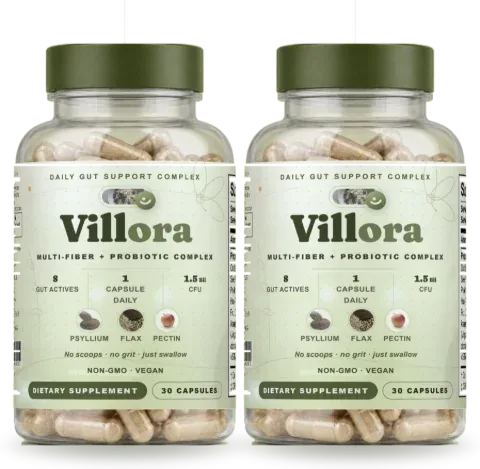
2 bottles
$69per bottle
- $138 total · 60 capsules
- $9.99 shipping
- $2.47 a day with shipping
- Good for trying the routine first
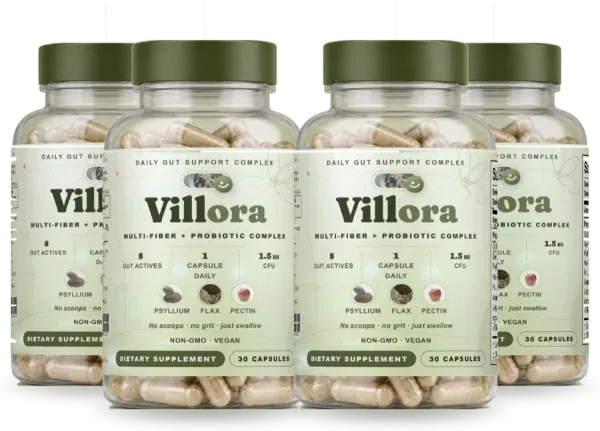
4 bottles
$59per bottle
- $236 total · 120 capsules
- Free US shipping
- about $1.97 a day
- Two digital guides included (sales page)
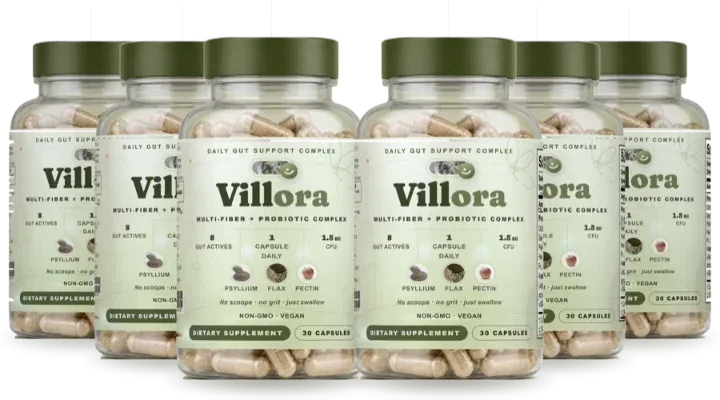
6 bottles
$49per bottle
- $294 total · 180 capsules
- Free US shipping
- about $1.63 a day
- Two digital guides included (sales page)

60-day money-back guarantee from the purchase date, per the sales page. Return the bottles, even empty, with tracking. Buyer pays return shipping. Questions: +1 (302) 200-3480 or [email protected].

Order links go to the official checkout through our checkout guide rules: check the address bar, the total and the shipping line before you pay. Tree-nut allergy? Do not order: the blend lists black walnut hull.
Questions people ask
Which Villora ingredient is present in the largest amount?
Oat bran powder. It is listed first in the 695 mg blend, and FDA rules list blend ingredients in descending order by weight.2 The label does not say how much oat bran there is.
Does the Villora formula list milligrams for each ingredient?
No. The panel shows one proprietary blend of 695 mg and no per-item amounts.1 Any site that gives exact milligrams for each item is guessing.
Is 695 mg the fiber content of one Villora capsule?
No. 695 mg is the weight of the whole blend, including whole-food powders and the probiotic. The fiber share is lower and not printed on the label.
Why does the Villora front label show psyllium but the panel lists oat bran first?
The icons on the front are design choices. The Supplement Facts panel is the ranked list, and on it psyllium is third.1
Which Villora ingredient raises an allergy concern?
Black walnut hull. Walnut is a tree nut, and the sales page says the product contains tree nuts.10 People with a tree-nut or walnut allergy should not take it.
Sources for this page
- Villora bottle front label and Supplement Facts panel (photographed on this site)
- FDA — Dietary Supplement Labeling Guide
- Dietary Guidelines for Americans
- MedlinePlus — High-fiber foods
- MedlinePlus — Dietary Fiber
- MedlinePlus — Fiber (encyclopedia)
- FDA eCFR 21 CFR 201.319 — water-soluble gums warning
- NCCIH — Flaxseed and Flaxseed Oil
- NCCIH — Probiotics: What You Need To Know
- Villora official sales page, read 23 November 2026 (prices, shipping and guarantee terms)
- FDA — Food Allergies
- Drugs.com — Black walnut (natural product monograph)
- FDA — Dietary Supplements