
What is the Villora dosage?
The Villora dosage is one capsule a day. The front label says "1 Capsule Daily", and the Supplement Facts panel gives a serving size of 1 capsule with 30 servings per container.1 There is no loading dose, no second capsule at night and no scoop to measure.
| Question | Answer from the label or sales page |
|---|---|
| How many capsules? | 1 capsule daily 1 |
| With food? | Yes, with breakfast or another meal you never skip 2 |
| With water? | Yes, a full glass 2 |
| What time? | About the same time each day 2 |
| Who for? | Adults 18+ 2 |
| How long does a bottle last? | 30 capsules, about 30 mornings 1 |
Taking more than one capsule will not make the label say anything different. If you want more fiber overall, food is the usual place to start, and our Villora ingredients page explains why one capsule is a small amount of fiber.

Step-by-step: your daily capsule
The routine takes less than a minute once it is set up. Here is the order we suggest, built from the sales page directions.2
- Pour a full glass of water before you open the bottle.
- Sit down to breakfast, or to the meal you never skip.
- Sit or stand upright and swallow one capsule whole.
- Drink the full glass of water, not just a sip.
- Close the bottle and put it back in the same spot.
- Stay upright for a while after; do not lie down right away.
The front label sums up the format as "No scoops · no grit · just swallow".1 That makes it simple, but the water step is not optional. We explain why next.
Why a full glass of water every time
A full glass of water matters because three of the label items, psyllium, konjac and apple pectin, are gel-forming fibers that swell when they meet liquid.1 Swallowing a swelling fiber with too little liquid can raise the risk of it lodging in the throat or chest.
US rules require a choking warning on over-the-counter drug products made with water-soluble gums such as psyllium and glucomannan, the fiber in konjac.3 Villora is sold as a dietary supplement rather than one of those drug products, but the fiber behaves the same way. MedlinePlus also advises drinking plenty of fluids whenever you add fiber.4
Stop and get urgent help if you have chest pain, vomiting, or trouble swallowing or breathing after taking a capsule. If swallowing pills is hard for you, ask a doctor before starting.
Why breakfast works as an anchor
Breakfast works well because it is a meal most people eat at a similar time every day, which makes the capsule easy to remember. The sales page suggests breakfast or any other meal you never skip.2 If you skip breakfast, lunch or dinner is just as valid.
Linking a new habit to something you already do is the simplest way to keep it. A few small tricks help:
- Keep the bottle next to the coffee maker, kettle or cereal.
- Fill your water glass first, so the water step is never forgotten.
- If you work shifts, tie it to your first meal after waking, whatever the clock says.
- Pick one meal and stick to it, rather than moving the capsule around.
Keep the bottle closed and out of reach of children, and follow any storage note printed on your label. The panel says the 1.5 billion CFU of Lactobacillus acidophilus is guaranteed at the time of manufacture, so handling the bottle with care makes sense.1
What if you miss a capsule?
If you miss a capsule, just take the next one at your usual meal the next day. Do not take two at once to make up for it. The label direction is one capsule daily, and there is no catch-up dose.1
If you remember later the same day and you are eating a meal, you can take it then with a full glass of water, as long as it does not clash with a medicine schedule your pharmacist has given you. Never take it at bedtime without food just to keep a streak going.
Travel and busy weeks
When traveling, keep the capsules in the original bottle so the label stays with them. That way anyone checking your bag, or a doctor if you need one, can read exactly what is inside. Our capsules per bottle page helps you plan how many you need for a trip.
Taking Villora with medicines
If you take any medicine, ask your pharmacist how to time Villora around it before you start. Fiber can change how some medicines are absorbed, and the right spacing depends on the medicine. Your pharmacist can see your full list and give you a schedule.
We do not give a set number of hours on this site, because a single rule would be wrong for some medicines. Bring the bottle to the pharmacy counter so the pharmacist can read the panel. The FDA also encourages people to tell their health care providers about every supplement they take.5
Our separate Villora and medications page has a checklist of what to bring and what to ask.
Who should check with a doctor before the first capsule
Some people should talk to a doctor or pharmacist before taking Villora, and some should not take it at all. Anyone with a walnut or tree-nut allergy should not take it, because the sales page says it contains tree nuts (walnut) and black walnut hull is on the panel.21
Ask first if you are pregnant or nursing, take any medicine, have trouble swallowing, have had a bowel blockage or narrowing, have a digestive condition, or have a weakened immune system or a serious illness. Some references advise avoiding black walnut preparations in pregnancy.6 It is for adults 18 and over.2
For a full fit and not-fit breakdown, see who should take Villora.
Common mistakes to avoid
Most problems with a fiber capsule come from small habits, not from the capsule itself. These are the ones we would watch for, all drawn from the directions and warnings above.
- Dry swallowing. Taking the capsule with a sip, or no water, skips the most important step.
- Taking it on the go. Swallowing while walking or driving makes it harder to drink a full glass.
- Lying down soon after. Stay upright so the capsule moves down easily.
- Doubling up. One capsule daily is the label direction; there is no extra dose for missed days.1
- Guessing about medicines. Ask a pharmacist instead of picking your own spacing.
- Ignoring warning signs. Chest pain, vomiting, or trouble swallowing or breathing need urgent help.
- Decanting into a pill box without the label. Keep the original bottle handy so the panel can be read.
None of these need special equipment. A glass of water by the bottle covers most of them. If you are someone who forgets, a phone reminder set to your usual mealtime is a simple backup.
One more point: Villora is a dietary supplement, and the FDA does not approve supplements before they are sold.7 That makes your own care in reading the label and following the directions more important, not less. NCCIH suggests talking to your health care providers before adding any supplement.8
What to expect in the first weeks
Expect a simple routine, not a dramatic change. We have not seen any study on the finished Villora product, and we do not give timelines. Some people notice mild gas or bloating at first, which is common with fiber and probiotics in general.49
It helps to remember the scale. The whole blend is 695 mg per capsule, including the probiotic and walnut hull.1 The Dietary Guidelines for Americans set a fiber goal of 14 g per 1,000 calories, so most of your fiber still comes from meals.10 Whole grains, beans, fruit and vegetables are the backbone of that.11
If an effect is strong or does not settle, stop and read our Villora side effects page. You can report a problem to the FDA through MedWatch.12 When you are ready to try it, you can check the current Villora offer.
Ready to order? Compare the three Villora packs
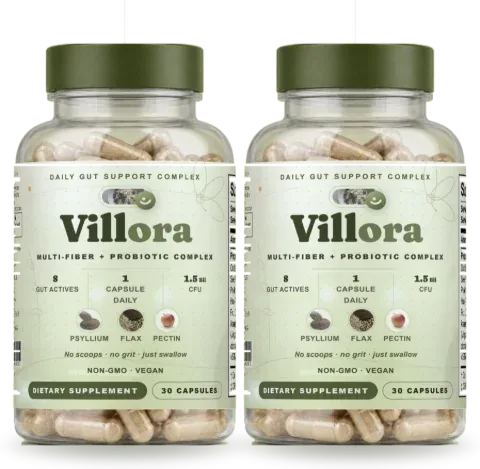
2 bottles
$69per bottle
- $138 total · 60 capsules
- $9.99 shipping
- $2.47 a day with shipping
- Good for trying the routine first
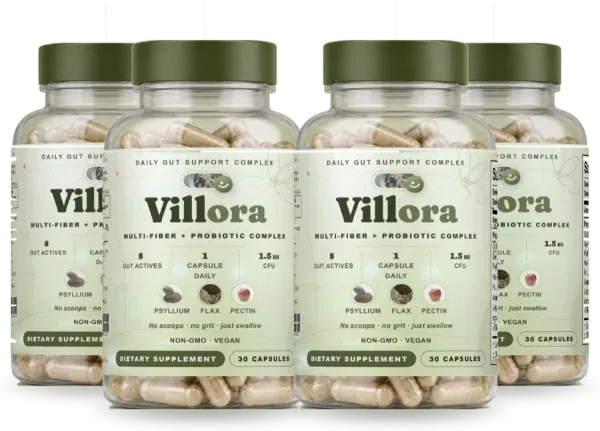
4 bottles
$59per bottle
- $236 total · 120 capsules
- Free US shipping
- about $1.97 a day
- Two digital guides included (sales page)
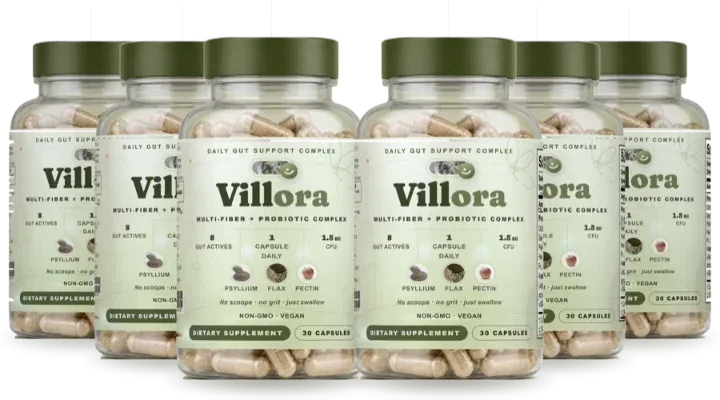
6 bottles
$49per bottle
- $294 total · 180 capsules
- Free US shipping
- about $1.63 a day
- Two digital guides included (sales page)

60-day money-back guarantee from the purchase date, per the sales page. Return the bottles, even empty, with tracking. Buyer pays return shipping. Questions: +1 (302) 200-3480 or [email protected].

Order links go to the official checkout through our checkout guide rules: check the address bar, the total and the shipping line before you pay. Tree-nut allergy? Do not order: the blend lists black walnut hull.
Questions people ask
Can I open the Villora capsule and mix it into food?
The label direction is to swallow the capsule, and the front label says "just swallow". We have not seen any direction for opening it. If swallowing capsules is hard for you, ask a doctor or pharmacist before using it.
Is it fine to take Villora with coffee instead of water?
The sales page says to take it with a full glass of water. Have your coffee if you like, but drink the full glass of water with the capsule too. The water is what the swelling fibers need.
Should I take Villora at night instead of the morning?
The sales page suggests breakfast or another meal you never skip, so an evening meal is fine if that is your steady meal. Avoid taking it right before lying down. Stay upright after swallowing it.
Can I take two Villora capsules on a bad day?
No. The label says one capsule daily, and we do not suggest going above it. If you feel you need more, talk to a doctor about your diet and symptoms.
Do I need to cycle off Villora after a bottle?
The label does not mention cycling or breaks. Whether to continue is your choice, ideally made with your doctor if you have any health condition. Stop at any time if it does not suit you.
Sources for this page
- Villora bottle front label and Supplement Facts panel (photographed on this site)
- Villora official sales page, read 23 November 2026 (prices, shipping and guarantee terms)
- FDA eCFR 21 CFR 201.319 — water-soluble gums warning
- MedlinePlus — Fiber (encyclopedia)
- FDA — Information for Consumers on Using Dietary Supplements
- Drugs.com — Black walnut (natural product monograph)
- FDA — Dietary Supplements
- NCCIH — Using Dietary Supplements Wisely
- NCCIH — Probiotics: What You Need To Know
- Dietary Guidelines for Americans
- MedlinePlus — High-fiber foods
- FDA — MedWatch adverse event reporting