
Who is Villora made for?
Villora is made for adults who want a capsule-based daily gut support product instead of a powder. The front label calls it a "Daily Gut Support Complex" and a "Multi-Fiber + Probiotic Complex", with "8 Gut Actives" in "1 Capsule Daily".1 The sales page lists it for adults 18 and over.2
It is a dietary supplement, not a medicine. The FDA does not approve dietary supplements for safety or effectiveness before they are sold.3 So the question of fit is really about your own health, habits and expectations. If you want a plain overview first, read what is Villora.
Signs Villora may suit you
Villora may suit you if most of the points below are true. None of them is a medical test; they are about habits and expectations.
- You are an adult aged 18 or over.2
- You have no walnut or tree-nut allergy.
- You prefer swallowing one capsule to mixing a powder: the label says "No scoops · no grit · just swallow".1
- You already eat a mostly balanced diet and see a capsule as a small add-on, not a replacement for food.
- You can take it with a meal and a full glass of water every day.2
- You do not take medicines, or your pharmacist has already advised on timing.
- You are happy with a product that does not list the amount of each ingredient.
The last point matters to some buyers. The 695 mg proprietary blend hides per-item amounts, and the probiotic line prints a placeholder where a strain code would go.1 Our Villora label page reads that panel line by line.
Who should not take Villora?
People with a walnut or tree-nut allergy should not take Villora. The sales page states that it contains tree nuts (walnut), and Black Walnut Hull Powder is printed on the Supplement Facts panel.21
Tree nuts are one of the major food allergens named by the FDA.4 FARE explains that tree-nut reactions can be serious.5 Cross-reactivity among tree nuts is possible, so a reaction to a different tree nut is a reason to talk to an allergist before trying it.6
Hulls are the outer covering of the nut, and some buyers assume that means no allergy risk. We do not make that assumption, and the sales page does not either: it lists tree nuts (walnut) as contained.2 If you are unsure whether you are allergic, an allergist can test you before you try any walnut product.
Children and teens are also outside the stated audience, because the sales page says adults 18+.2 And anyone who has had chest pain, vomiting or trouble swallowing after a fiber product before should not try it without a doctor's advice.
Fit and not-fit at a glance
This table sorts common situations into three groups. It is a starting point for a conversation with your doctor, not a decision tool on its own.
| Situation | Our reading | Why |
|---|---|---|
| Healthy adult, no allergies, no medicines | May suit | Matches the stated audience 2 |
| Under 18 | Skip | Sales page says adults 18+ 2 |
| Walnut or tree-nut allergy | Skip | Contains tree nuts (walnut) 2 |
| Pregnant or nursing | Ask a doctor first | Black walnut caution in pregnancy 6 |
| Takes any medicine | Ask a pharmacist first | Fiber can change absorption of some medicines |
| Trouble swallowing | Ask a doctor first | Gel-forming fibers swell with liquid 7 |
| Past bowel blockage or narrowing | Ask a doctor first | Swelling fibers need a clear passage |
| Digestive condition | Ask a doctor first | Fiber changes can affect symptoms |
| Weakened immune system or serious illness | Ask a doctor first | Rare serious probiotic problems reported 8 |
Pregnancy and nursing
If you are pregnant or nursing, ask your doctor before taking Villora. Some references advise avoiding black walnut preparations during pregnancy, and black walnut hull is one of the eight label items.61
The panel does not say how much black walnut hull is in the blend, so a doctor cannot work out the exact amount from the label alone.1 Bring the bottle anyway; seeing the full ingredient list helps them advise you. The FDA suggests talking to a health care provider before taking supplements while pregnant or nursing.9
If you take medicines
If you take any prescription or over-the-counter medicine, speak to your pharmacist before adding Villora. Fiber can change how some medicines are absorbed, and the right gap between them depends on the medicine itself.
We do not publish a single spacing rule, because no one number fits every medicine. Your pharmacist can look at your list and give you a schedule that works. Our Villora and medications page lists what to bring and which questions to ask.
Digestive conditions, swallowing and immune health
People with a digestive condition, trouble swallowing, a past bowel blockage or narrowing, or a weakened immune system should get a doctor's advice before starting Villora. These are the groups for whom fiber or probiotics carry more risk.
Swallowing and blockage
Psyllium, konjac and apple pectin are gel-forming fibers that swell with liquid.1 US rules require a choking warning on over-the-counter drug products made with water-soluble gums such as psyllium and glucomannan.7 If swallowing is hard, or your bowel has narrowed before, a swelling fiber is not something to try on your own.
Immune health and serious illness
NCCIH notes that probiotics have a good safety record in healthy people, but that people with serious illness or weakened immune systems have had rare serious problems.8 The NIH Office of Dietary Supplements gives similar advice.10 Villora contains Lactobacillus acidophilus at 1.5 billion CFU at manufacture.1
Ongoing gut symptoms
If you are thinking about Villora because of ongoing gut symptoms, see a doctor about the symptoms first. A supplement is no substitute for finding out what is going on. Blood in the stool, weight change you cannot explain, or severe or lasting belly pain all need a doctor's visit, whatever products you use.
How to talk to your doctor about Villora
The simplest way to get useful advice is to bring the bottle, or a clear photo of the Supplement Facts panel, to your appointment. The panel lists all eight items in order, the 695 mg blend total and the 1.5 billion CFU probiotic line.1 That gives your doctor more to work with than a product name.
It also helps to prepare a few short notes before the visit. A doctor or pharmacist can then answer in a few minutes rather than guessing.
- Every medicine you take, with the dose and time of day.
- Other supplements, including fiber powders, vitamins and other probiotics.
- Any food allergies, especially to walnut or other tree nuts.
- Past swallowing problems or bowel surgery.
- Whether you are pregnant, trying to become pregnant or nursing.
- What you hope a gut support capsule will add to your routine.
NCCIH advises telling all your health care providers about any supplement you use, so they can give coordinated advice.11 MedlinePlus also has a plain guide to dietary supplements if you want background reading before the visit.12
If your doctor says it is fine, follow the label: one capsule a day with a meal and a full glass of water. Our how to take Villora page lays out the routine step by step. If your doctor advises against it, that answer is worth more than any label or ad.
Setting fair expectations
The right person for Villora also has realistic expectations. We have seen no study on the finished Villora product. The ads tell a "sweep, cleanse, repair" story, but that is ad language, not something the label claims or that we can confirm.
One capsule holds a 695 mg blend, which includes the probiotic and walnut hull, so it is not 695 mg of fiber.1 The Dietary Guidelines for Americans set a fiber goal of 14 g per 1,000 calories.13 Fiber is part of a normal diet, and foods such as beans, whole grains, fruit and vegetables supply most of it.14
- Check the allergy rule first.
- Check the ask-first list next.
- Decide whether a capsule fits your routine better than food changes alone.
- Read our Villora side effects page before your first dose.
If you pass those steps and want to try it, you can check the current Villora offer.
Ready to order? Compare the three Villora packs
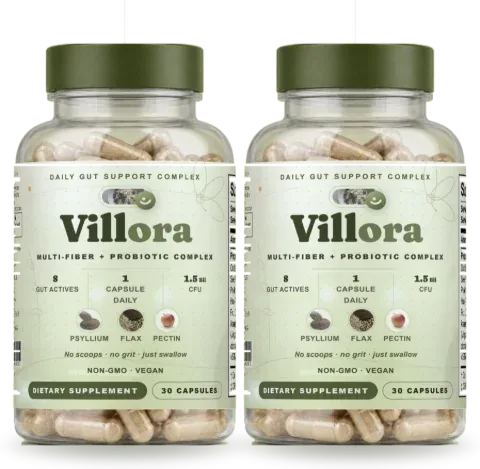
2 bottles
$69per bottle
- $138 total · 60 capsules
- $9.99 shipping
- $2.47 a day with shipping
- Good for trying the routine first
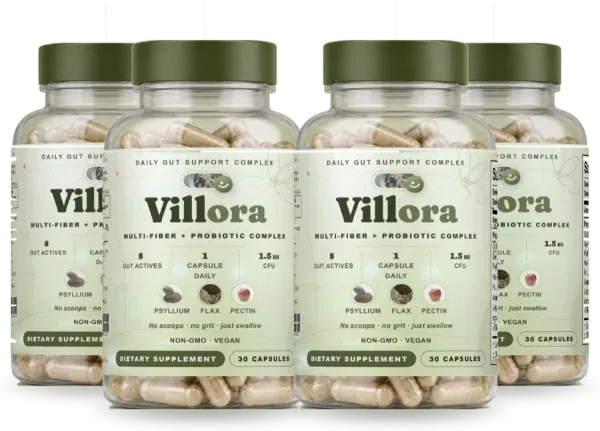
4 bottles
$59per bottle
- $236 total · 120 capsules
- Free US shipping
- about $1.97 a day
- Two digital guides included (sales page)
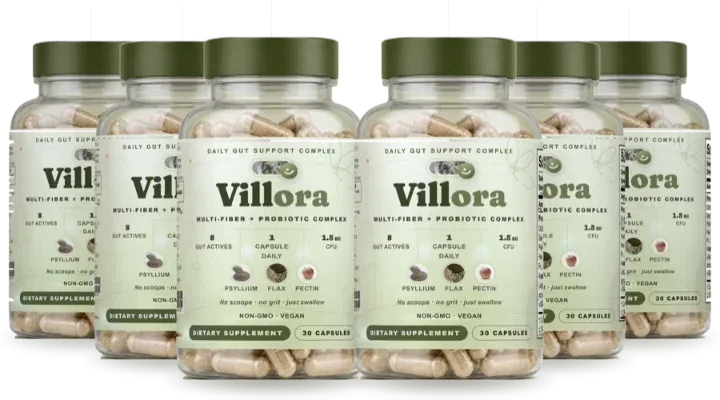
6 bottles
$49per bottle
- $294 total · 180 capsules
- Free US shipping
- about $1.63 a day
- Two digital guides included (sales page)

60-day money-back guarantee from the purchase date, per the sales page. Return the bottles, even empty, with tracking. Buyer pays return shipping. Questions: +1 (302) 200-3480 or [email protected].

Order links go to the official checkout through our checkout guide rules: check the address bar, the total and the shipping line before you pay. Tree-nut allergy? Do not order: the blend lists black walnut hull.
Questions people ask
Can a 17-year-old take Villora?
No. The sales page says Villora is for adults 18 and over. Teens interested in more fiber can talk to a doctor about food sources instead.
Is Villora a good fit if I have a peanut allergy but no tree-nut allergy?
Peanuts are legumes, not tree nuts, but people with food allergies should still ask an allergist before trying a product that contains walnut. Your allergist knows your history and can advise you safely.
Should older adults take Villora?
The sales page lists adults 18+, with no upper age limit stated. Older adults are more likely to take medicines or have swallowing issues, so checking with a doctor or pharmacist first is a sensible step.
Is Villora for someone who already eats plenty of fiber?
It may add little for them. One capsule is a small amount of fiber next to daily goals, so people who already eat fiber-rich meals may not see the point. That choice is personal.
Can I take Villora if I have an ongoing bowel condition?
Ask your doctor before starting. A digestive condition is on the ask-first list, and swelling fibers or probiotics may not suit every condition.
Sources for this page
- Villora bottle front label and Supplement Facts panel (photographed on this site)
- Villora official sales page, read 23 November 2026 (prices, shipping and guarantee terms)
- FDA — Dietary Supplements
- FDA — Food Allergies
- FARE — Tree nut allergy
- Drugs.com — Black walnut (natural product monograph)
- FDA eCFR 21 CFR 201.319 — water-soluble gums warning
- NCCIH — Probiotics: What You Need To Know
- FDA — Information for Consumers on Using Dietary Supplements
- NIH Office of Dietary Supplements — Probiotics fact sheet
- NCCIH — Using Dietary Supplements Wisely
- MedlinePlus — Dietary Supplements
- Dietary Guidelines for Americans
- Harvard T.H. Chan School of Public Health — The Nutrition Source: Fiber