
How is Villora different from a stand-alone probiotic?
Villora is mainly a fiber blend with one probiotic added, while a stand-alone probiotic is built around live cultures and usually has little or no fiber. The Villora front label calls it a "Multi-Fiber + Probiotic Complex" with "8 Gut Actives," and seven of those eight are plant items.1
| Feature | Villora | Typical stand-alone probiotic |
|---|---|---|
| Main purpose on label | Fiber blend plus one culture | Live cultures |
| Number of species | 1 (L. acidophilus) | One or several, varies |
| CFU per serving | 1.5 billion | Often 1 to 10 billion, some higher |
| When CFU is counted | At time of manufacture | Manufacture or through expiration |
| Strain code | Placeholder, none given | Often listed, check the label |
| Fiber included | Yes, 7 fiber and plant items | Usually none |
| Tree nuts | Contains walnut | Check its label |
The table shows that the two types answer different questions. One is about fiber with a probiotic on the side. The other is about the probiotic itself. See the full list on our Villora ingredients page.
Is 1.5 billion CFU low compared with other probiotics?
It is on the low side of the range most commonly seen. The NIH Office of Dietary Supplements says many probiotic supplements provide 1 to 10 billion CFU per dose, and some provide far more.2
ODS is also clear that a bigger number does not automatically mean a better product.2 What matters more is which strain is used and whether that strain has been studied at a given dose. So comparing raw CFU numbers can mislead. A small count of a well-described strain is easier to judge than a large count of an unnamed one.
- Villora: 1.5 billion CFU, one species.1
- Many probiotic products: 1 to 10 billion CFU, one or several species.2
- Higher CFU: not proof of better effects.
- The fair question: which strain, how much, and counted when?
For a closer look at Villora's culture on its own terms, read our Villora Lactobacillus acidophilus page.
Why does a strain ID matter when you compare?
A strain ID matters because probiotic research is done on specific strains, and results for one strain do not carry over to another. NCCIH notes that different probiotic strains can have different effects.3
On Villora's panel, the place where a strain code would go reads «STRAIN ID», with no actual code.1 That leaves only the genus and species. Many probiotic products print a full name with a strain code after the species, which lets a buyer or a clinician look up research on that exact organism.
If you are choosing between a fiber-plus-probiotic product and a dedicated probiotic for a specific reason, the strain code is the first thing to ask about. Without it, you cannot match a product to published studies.
We list this as a gap in our Villora label review. You can ask the seller about it at [email protected] or +1 (302) 200-3480.
What should you check on any probiotic label?
Check five things on any probiotic label: the full name with strain, the CFU count, when that count applies, storage directions and the other ingredients. ODS describes the genus, species and strain naming system and explains that CFU counts may be stated at manufacture or at expiration.2
- Full name: genus, species and a strain code. Villora gives genus and species only.1
- CFU per serving: Villora states 1.5 billion.
- Timing of the count: Villora says at time of manufacture, not at expiration.
- Storage: follow the bottle. Keep any live-culture product closed, dry and away from heat.
- Other ingredients and allergens: Villora also contains seven plant items, including black walnut hull.
Running the same checklist on every product you consider keeps the comparison fair. It also shows where a label is complete and where it leaves you to ask the seller. The FDA does not approve dietary supplements for safety or effectiveness before they reach the market, so the label and your own questions carry a lot of weight.4
If you write down the answers for two or three products side by side, the differences usually become clear quickly. One product may name its strain but have no fiber. Another may have fiber but no strain code. Neither fact alone makes a product good or bad. It simply tells you what you are buying.
Why would a maker combine fiber and a probiotic?
Makers combine them because fiber and gut bacteria are closely linked in general nutrition writing. The Harvard Nutrition Source explains that some types of fiber are fermented by bacteria in the colon.5 That is a general fact about fiber, not a finding about Villora.
A combined product offers one capsule instead of two. The trade-off is that each part is small. The whole Villora blend is 695 mg, and the panel does not show how that weight splits between fibers and the culture.1 By comparison, the daily fiber goal is about 14 g per 1,000 calories.6
- Combined capsule: one step, but a small amount of each part.
- Separate products: more pills, but each one's amount is visible.
- Food: still the main source of fiber for most people.
- Fermented foods: part of many diets, though not the same as a measured supplement.
Some people already take a probiotic and wonder if Villora would double up. Talk to a pharmacist or doctor before adding a second product, and bring both labels.
How do the costs compare?
Villora costs about $1.63 to $2.47 per day depending on pack size, according to the sales page.7 Stand-alone probiotic prices vary widely, so compare by cost per daily serving and by what that serving contains.
| Villora pack | Total | Supply | Cost per day |
|---|---|---|---|
| 2 bottles | $138 plus $9.99 shipping | 60 days | $2.30 ($2.47 with shipping) |
| 4 bottles | $236 (free US shipping) | 120 days | about $1.97 |
| 6 bottles | $294 (free US shipping) | 180 days | about $1.63 |
With Villora you pay for both a fiber blend and a culture in one capsule. If you only want a probiotic, you would be paying for fiber you may not need. If you only want fiber, a plain fiber product may give more grams for less. Prices can change, so check the live checkout. Our Villora price page has the full breakdown.
Which product type might fit which person?
The right type depends on what you want from a supplement and what your clinician advises, not on which label has a bigger number. We cannot give personal medical advice, but we can outline the general fit.
A combined fiber-plus-probiotic capsule may fit if
- You want one simple daily capsule with breakfast.
- You are interested in a mix of fiber types more than a specific strain.
- You have no tree-nut or walnut allergy.
A dedicated probiotic may fit if
- Your clinician has suggested a specific strain.
- You want the strain code and count printed clearly.
- You do not want fiber or tree nuts in the same product.
NCCIH advises telling your health care providers about any supplements you take.8 Our who should take Villora page has a longer fit and not-fit list.
What safety points apply to both?
Both product types can cause temporary gas, bloating or stomach discomfort, and both need medical advice for people with weakened immune systems. NCCIH notes rare serious infections from probiotics in people with serious illness or compromised immunity.3
- Villora contains black walnut hull and tree nuts. Do not take it with a walnut or tree-nut allergy.
- Villora contains gel-forming fibers. Take it with a full glass of water, and stop and get urgent help for chest pain, vomiting, or trouble swallowing or breathing.
- Ask a doctor or pharmacist first if pregnant, nursing, on any medicine, or living with a digestive condition.
- Report serious reactions through FDA MedWatch.9
We saw no studies on the finished Villora product. If you decide a combined capsule suits you, follow the label: one capsule daily with breakfast and water. You can check the current Villora offer on the live checkout, and read Villora side effects first.
Ready to order? Compare the three Villora packs
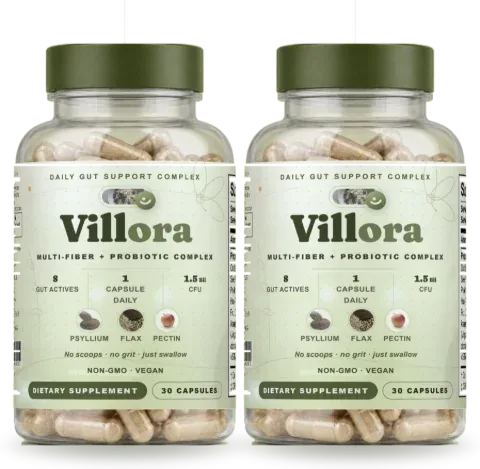
2 bottles
$69per bottle
- $138 total · 60 capsules
- $9.99 shipping
- $2.47 a day with shipping
- Good for trying the routine first
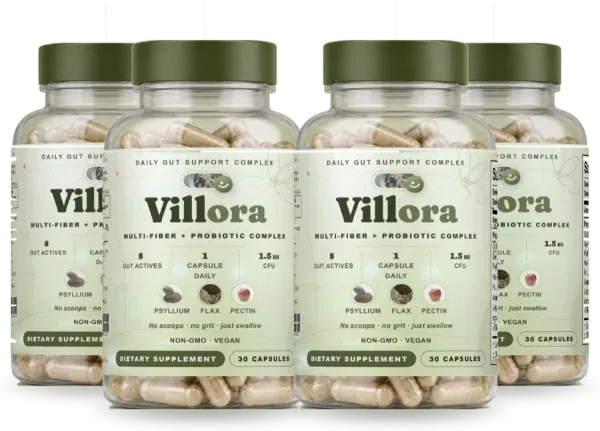
4 bottles
$59per bottle
- $236 total · 120 capsules
- Free US shipping
- about $1.97 a day
- Two digital guides included (sales page)
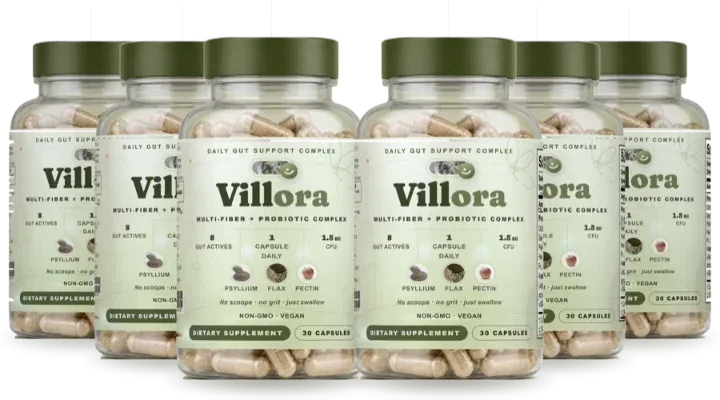
6 bottles
$49per bottle
- $294 total · 180 capsules
- Free US shipping
- about $1.63 a day
- Two digital guides included (sales page)

60-day money-back guarantee from the purchase date, per the sales page. Return the bottles, even empty, with tracking. Buyer pays return shipping. Questions: +1 (302) 200-3480 or [email protected].

Order links go to the official checkout through our checkout guide rules: check the address bar, the total and the shipping line before you pay. Tree-nut allergy? Do not order: the blend lists black walnut hull.
Questions people ask
Can Villora replace the probiotic I already take?
Ask your doctor or pharmacist before swapping. Villora lists one species at 1.5 billion CFU with no strain code, so it may not match the product you use now.1 Bring both labels to compare.
Does Villora have more than one probiotic species?
No. The panel lists only Lactobacillus acidophilus.1 Many stand-alone probiotics list one or several species, each ideally with a strain code.
Is a higher CFU probiotic better than Villora's 1.5 billion?
Not necessarily. ODS says higher CFU counts do not necessarily mean a product is more effective.2 The strain and the evidence behind it matter more than the number alone.
Is it a problem to take Villora and a separate probiotic together?
We cannot say for your case, so ask a pharmacist or doctor. Taking two products means two sets of ingredients, and Villora also adds fiber and black walnut. Tell your providers about every supplement you use.8
Why compare Villora with probiotic products if it is mostly fiber?
Because the front label names it a "Multi-Fiber + Probiotic Complex" and prints the CFU count prominently.1 Many buyers want to know how that probiotic part stacks up. The honest answer is that it is a small, single-species dose without a named strain.
Sources for this page
- Villora bottle front label and Supplement Facts panel (photographed on this site)
- NIH Office of Dietary Supplements — Probiotics fact sheet
- NCCIH — Probiotics: What You Need To Know
- FDA — Dietary Supplements
- Harvard T.H. Chan School of Public Health — The Nutrition Source: Fiber
- Dietary Guidelines for Americans
- Villora official sales page, read 23 November 2026 (prices, shipping and guarantee terms)
- NCCIH — Using Dietary Supplements Wisely
- FDA — MedWatch adverse event reporting