
What probiotic does Villora contain?
Villora contains one probiotic species, Lactobacillus acidophilus, at 1.5 billion CFU per capsule.1 The front label repeats the figure as "1.5 Bil CFU" and calls the product a "Multi-Fiber + Probiotic Complex." No other bacteria or yeasts are listed.
NCCIH describes probiotics as live microorganisms that are intended to have health benefits when eaten or applied to the body.2 Lactobacillus is one of the most common groups found in probiotic products. Being common does not mean every product in that group behaves the same way, which we come back to below.
The probiotic sits at the end of a list that is otherwise made of fibers and plant powders. See the full list on our Villora ingredients page.

What does 1.5 billion CFU mean?
CFU stands for colony-forming units, a count of how many live microbes in a dose are able to grow and form colonies.3 The NIH Office of Dietary Supplements explains that probiotic amounts on labels are given in CFU rather than by weight alone.
ODS also notes that many probiotic supplements contain 1 to 10 billion CFU per dose, and that a higher CFU count does not necessarily mean a product has better health effects.3 So 1.5 billion sits at the lower end of a common range. That is a fact about the number, not a judgment about the product.
| Label detail | What Villora prints | What it tells you |
|---|---|---|
| Species | Lactobacillus acidophilus | Genus and species only |
| Count | 1.5 billion CFU | Live units per capsule |
| When the count applies | At time of manufacture | Not at end of shelf life |
| Strain code | Placeholder «STRAIN ID» | No strain is identified |
| Servings | 1 capsule, 30 per bottle | About 30 mornings |
If you want to compare this number with stand-alone probiotic products, our Villora vs probiotic capsules page walks through it without naming brands.
Why does "at time of manufacture" matter?
It matters because probiotics are live, and the number of live units can drop between the day a product is made and the day you take it. The Villora panel says the 1.5 billion CFU is guaranteed at the time of manufacture.1
ODS points out that some labels state CFU at the time of manufacture, while others state it through the expiration date, and that the count may fall over time.3 A count stated through the end of shelf life is more useful to a buyer, because it describes what is left in the bottle when you use it.
- A count at manufacture describes the capsule on the day it was made.
- A count through expiration describes the minimum left at the use-by date.
- Villora's label uses the first wording.
- The label images we reviewed do not state an expected count at expiration.
This is not unusual, but it is a detail worth knowing. We think a buyer should read 1.5 billion as a starting figure rather than a promise for the last capsule in the bottle.
Why is there no strain ID on the label?
We do not know why. The panel prints a placeholder that reads «STRAIN ID» where a strain code would usually go, and no actual code is given.1 We will not guess one or fill it in.
Strains matter. ODS explains that probiotics are named by genus, species and strain, and that different strains of the same species can have different effects.3 NCCIH makes the same point: research on one strain does not automatically apply to another.2
Without a strain code, it is not possible to match the probiotic in Villora to any specific published study. This is one of the main gaps we flag in our Villora label review.
If the strain matters to you, ask the seller before you buy. The sales contacts are the phone line +1 (302) 200-3480 and [email protected]. Ask them to name the strain and say whether the count is guaranteed through expiration.
How should Villora be stored to protect the probiotic?
Store it as the label directs, and where no detail is given, keep the bottle closed, dry and away from heat. Probiotics are live organisms, so moisture and warmth are the main things to keep away from the capsules. The label images we reviewed do not show a refrigeration line.
- Read the bottle for any storage line before you open it.
- Close the cap tightly after each use so moisture stays out.
- Keep the bottle away from the stove, a sunny window or a hot car.
- Do not move capsules into a pill box for long periods unless the label allows it.
- Check the use-by date and use the bottle within that time.
These are general habits for any live-culture product. They do not change the fact that the label states the CFU count at manufacture only.
Why put a probiotic in a fiber capsule?
The maker combines one probiotic with seven fiber and plant powders and sells the result as a "Multi-Fiber + Probiotic Complex."1 The label does not explain the reasoning, so we can only describe the general idea behind such pairings.
Some fibers are fermented by bacteria in the large intestine, and the Harvard Nutrition Source describes fiber as food for gut microbes as part of a healthy diet.4 That general picture is why fiber and probiotics are often discussed together. It is not evidence that the specific mix in Villora does anything in particular.
There is also a practical point. Because the probiotic is counted in CFU and the blend is weighed in milligrams, the two parts of the capsule are measured in different ways. The 695 mg figure covers the whole blend, and the panel does not split out how much of that weight belongs to the culture.1 Fiber in a single capsule is small compared with a daily goal of about 14 g per 1,000 calories.5
- Seven items are fibers or plant powders; one is a live culture.
- The culture is last on the list, measured by count rather than weight.
- No synergy claim appears on the Supplement Facts panel.
- The "sweep, cleanse, repair" wording comes from the ads, not the label.
If you already take a separate probiotic, tell your pharmacist or doctor before adding Villora so they can look at the full picture. Our how to take Villora page covers timing with breakfast and water.
What does research on probiotics show in general?
Research on probiotics in general is mixed and depends heavily on the strain, the dose and the person. NCCIH says some probiotics have shown promise for certain uses, but for many conditions the evidence is limited or inconsistent.2
ODS adds that scientists are still learning which probiotics are helpful and for whom, and that results from one product cannot be carried over to another.3 We saw no studies on the finished Villora product, and the missing strain ID makes it impossible to link it to strain-specific research.
- Probiotic effects are often strain-specific.
- More CFU does not automatically mean more effect.
- Most people who use probiotics have mild or no side effects.
- Some groups need medical advice before using them.
This is why we describe Villora as a product sold as daily gut support, rather than saying what its probiotic does. For the bigger picture of how fiber and probiotics are discussed, read how does Villora work.
Who should ask a clinician before taking the probiotic?
People with a weakened immune system or a serious illness should talk to a doctor before taking any probiotic. NCCIH notes that in people with serious illnesses or compromised immune systems, probiotics have in rare cases been linked to serious infections.2
- Weakened immune system, serious illness, or a recent hospital stay.
- Pregnant or nursing.
- Taking any prescription or over-the-counter medicine.
- A digestive condition, trouble swallowing, or a past bowel blockage or narrowing.
- A tree-nut or walnut allergy: do not take Villora, as black walnut hull is on the panel.
Temporary gas, bloating or stomach discomfort can happen with fiber and probiotics, especially at first. Take one capsule daily with breakfast and a full glass of water, and follow the label. Report any serious reaction through FDA MedWatch.6 Our Villora side effects page covers this in more detail, and you can check the current Villora offer when you are ready.
Ready to order? Compare the three Villora packs
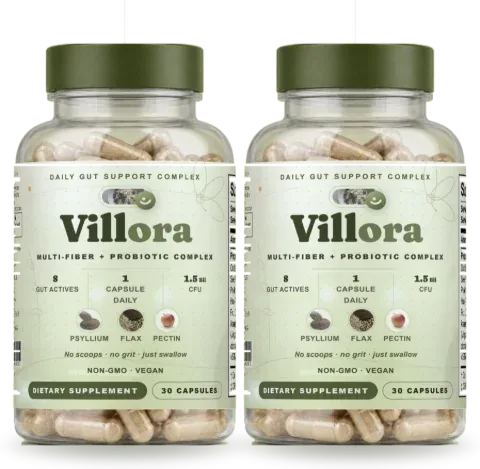
2 bottles
$69per bottle
- $138 total · 60 capsules
- $9.99 shipping
- $2.47 a day with shipping
- Good for trying the routine first
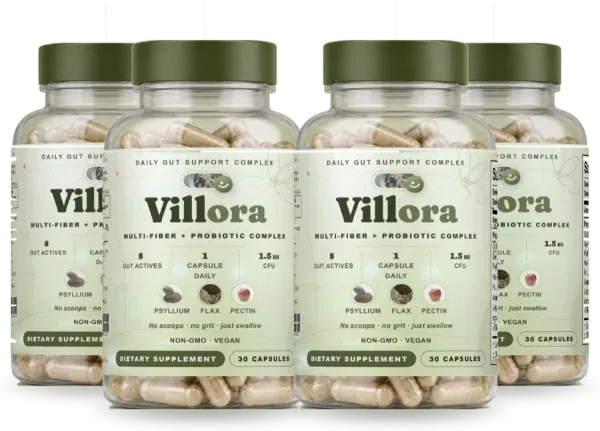
4 bottles
$59per bottle
- $236 total · 120 capsules
- Free US shipping
- about $1.97 a day
- Two digital guides included (sales page)
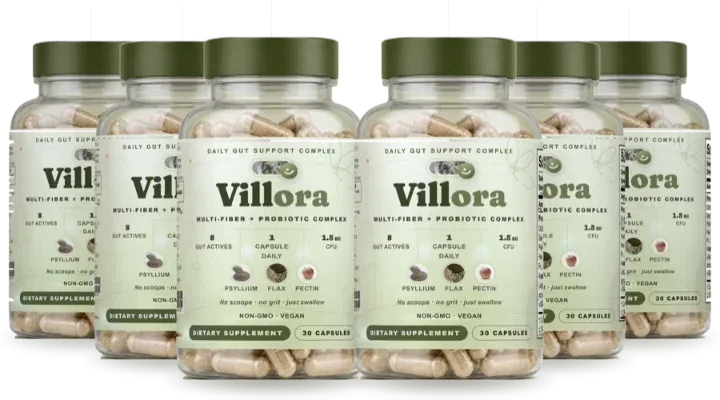
6 bottles
$49per bottle
- $294 total · 180 capsules
- Free US shipping
- about $1.63 a day
- Two digital guides included (sales page)

60-day money-back guarantee from the purchase date, per the sales page. Return the bottles, even empty, with tracking. Buyer pays return shipping. Questions: +1 (302) 200-3480 or [email protected].

Order links go to the official checkout through our checkout guide rules: check the address bar, the total and the shipping line before you pay. Tree-nut allergy? Do not order: the blend lists black walnut hull.
Questions people ask
Is 1.5 billion CFU a high dose for a probiotic?
It is at the lower end of a common range. ODS says many probiotic supplements contain 1 to 10 billion CFU per dose.3 A higher number does not necessarily mean better effects, so the count alone does not rank a product.
Which strain of Lactobacillus acidophilus is in Villora?
The label does not say. The panel shows a «STRAIN ID» placeholder instead of a strain code.1 Ask the seller at [email protected] if the strain matters to you.
Will each Villora capsule still have 1.5 billion live CFU when I take it?
The label only guarantees the count at the time of manufacture.1 Live counts can fall over time, so the number at the end of the bottle may be lower. Storing the bottle closed, dry and cool is a sensible habit.
Does the Villora probiotic need to be refrigerated?
The label images we reviewed do not include a refrigeration instruction. Follow whatever the bottle says, and keep it tightly closed and away from heat. If you are unsure, ask the seller before you change how you store it.
Can someone with a weak immune system take the probiotic in Villora?
They should talk to a doctor first. NCCIH notes that probiotics have been linked to serious infections in rare cases in people with compromised immune systems.2 Do not start it without medical advice.
Sources for this page
- Villora bottle front label and Supplement Facts panel (photographed on this site)
- NCCIH — Probiotics: What You Need To Know
- NIH Office of Dietary Supplements — Probiotics fact sheet
- Harvard T.H. Chan School of Public Health — The Nutrition Source: Fiber
- Dietary Guidelines for Americans
- FDA — MedWatch adverse event reporting