
What is the plum powder in Villora?
The plum powder in Villora is a powdered fruit ingredient printed on the Supplement Facts panel as "Plum Powder (Prunus domestica) fruit."1 Prunus domestica is the common European plum, the kind most often dried into prunes. The label names the plant part as the fruit, so this is not a seed, leaf or bark extract.
The panel does not say whether the powder is made from fresh plums or from dried prunes, and it does not name any extract ratio or standardized compound. We read it as a whole-fruit powder because that is all the label states. We will not guess at a process the label does not describe.
Plum powder sits inside a proprietary blend with oat bran, flax seed, psyllium husk, apple pectin, konjac root, black walnut hull and Lactobacillus acidophilus. You can see all eight items in label order on our Villora ingredients page.
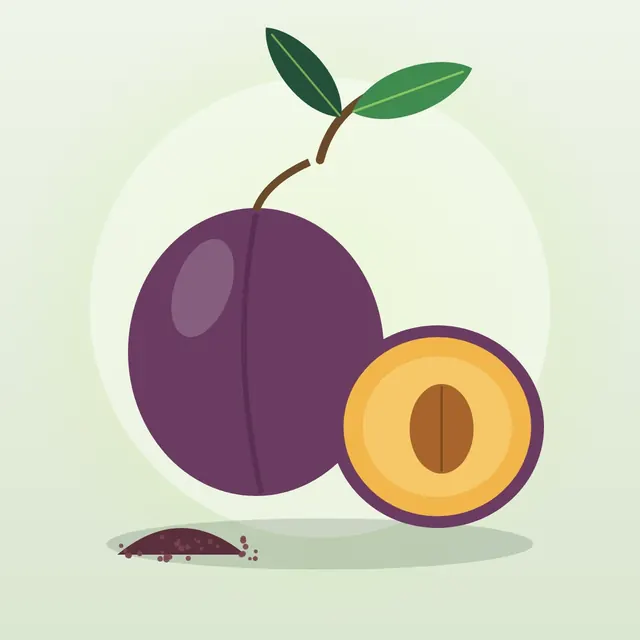
Where does plum powder appear in the blend order?
Plum powder is seventh of eight, which means it is near the end of the list.1 U.S. rules say ingredients inside a proprietary blend are listed in descending order of weight, even when the individual amounts are not disclosed.2 So plum powder is present in a smaller or equal amount compared with each of the six items above it.
| Position | Label item | Plant part |
|---|---|---|
| 1 | Oat Bran Powder (Avena sativa) | bran |
| 2 | Flax Seed Powder (Linum usitatissimum) | seed |
| 3 | Psyllium Husk Powder (Plantago ovata) | husk |
| 4 | Apple Pectin Powder (Malus spp.) | fruit |
| 5 | Konjac Root Powder (Amorphophallus konjac) | corm |
| 6 | Black Walnut Hull Powder (Juglans nigra) | hull |
| 7 | Plum Powder (Prunus domestica) | fruit |
| 8 | Lactobacillus acidophilus, 1.5 billion CFU | probiotic |
The last item, the probiotic, is measured in colony-forming units rather than milligrams, so its weight share is hard to judge. What we can say is that plum is one of the smaller fiber and plant items in a blend that totals 695 mg for everything combined.1
How much plum powder is in one capsule?
We do not know, and the label does not say. The panel gives only the total blend weight of 695 mg, with no milligrams for any single ingredient.1 That is legal for a proprietary blend, but it means no one outside the maker can state the plum amount.
Here is the simple math that is possible. If eight items share 695 mg and the list runs from heaviest to lightest, an even split would be under 90 mg each. Plum sits near the bottom, so it is reasonable to expect it is a modest share. But even that is an estimate, not a fact, and the real figure could be higher or lower than any even split.
- Total blend per capsule: 695 mg, including all eight items.1
- Plum milligrams: not disclosed.
- Extract strength or ratio: not stated.
- Serving size: 1 capsule; 30 servings per bottle.1
If the exact amount matters to you, the only reliable route is to ask the seller directly using the contacts on our contact page. We have not received a breakdown, and we will not publish one we have not seen.
Why are plums and prunes known as a food?
Plums and prunes are familiar fruits, and fruit is one of the everyday food groups that health sites list as a source of dietary fiber.3 MedlinePlus explains that fiber comes from plant foods such as fruits, vegetables, whole grains and beans, and that most people do well by getting it from a mix of these foods.4
NIDDK's eating guidance for people with constipation also points to fruit, vegetables and whole grains as everyday fiber sources, along with drinking enough fluid.5 That is food guidance. It does not describe plum powder in a capsule, and it does not say anything about Villora.
A whole prune or a serving of fresh plums is a food portion measured in grams. The plum powder in one Villora capsule is a fraction of a 695 mg blend. These are not equivalent, and we do not suggest one stands in for the other.
So the honest framing is this: plums have a long history as a food, and fruit is part of a normal high-fiber diet. That background explains why a maker might include plum. It does not tell you what a small amount of plum powder inside a capsule will do.
What can plum powder in a capsule not tell you?
The label does not let anyone claim a specific effect from the plum powder in Villora. We saw no studies on the finished Villora product, and the plum amount is hidden inside the blend.1 Without those two things, any claim about plum's role would be a guess.
- It is not a substitute for eating fruit. A serving of fruit gives far more plum or prune than a capsule share can.
- It does not come with a stated sorbitol or fiber value. The panel lists no fiber grams at all.
- It is not described as an extract with a set strength.
- It is not the main fiber source in the blend. Oat bran, flax and psyllium are listed first.
Dietary supplements are not reviewed by the FDA for effectiveness before they are sold.6 That is why we stick to the label and to general food sources, and why we say plainly when the evidence is not there. For a broader look at what the whole capsule can and cannot add, see Villora results.
How does plum fit with daily fiber goals?
Plum powder adds very little to daily fiber goals, because the entire Villora blend is only 695 mg. The Dietary Guidelines for Americans set a fiber goal of about 14 g per 1,000 calories eaten.7 On a 2,000-calorie day, that is about 28 g.
| Item | Amount | Share of a 28 g day |
|---|---|---|
| Whole Villora blend (all 8 items) | 695 mg (0.695 g) | about 2.5% |
| Plum powder alone | Not disclosed | A smaller part of that 2.5% |
| Daily fiber goal at 2,000 calories | about 28 g | 100% |
Keep in mind that 695 mg is the weight of the whole blend, not 695 mg of fiber. Some of that weight is plant material that is not fiber, and part of it is the probiotic. Food sources of fiber, such as whole fruit, also bring water and other nutrients that a powder share does not. If you want to see how far a capsule goes, our is Villora worth it page compares cost per day with plain fiber options.
Is plum powder a safety concern?
Plum is a common food, and we found nothing on the label that marks plum powder as a special risk. The cautions for Villora come mainly from other items in the blend and from the capsule format as a whole.
- Black walnut hull is on the panel, and the sales page says the product contains tree nuts. Anyone with a tree-nut or walnut allergy should not take Villora.
- Psyllium, konjac and pectin are gel-forming fibers. Take the capsule with a full glass of water.
- Fiber and probiotics can cause temporary gas, bloating or stomach discomfort, especially at first.
- Ask a doctor or pharmacist first if you are pregnant or nursing, take any medicine, or have a digestive condition, trouble swallowing or a past bowel blockage.
Stop and get urgent help if you have chest pain, vomiting, or trouble swallowing or breathing after taking a fiber capsule. U.S. rules require a choking warning on over-the-counter drug products made with water-soluble gums such as psyllium and glucomannan.8
If you have a reaction to any supplement, you or your clinician can report it to the FDA through MedWatch.9 For the full picture on safety, read is Villora safe. When you are ready, you can check the current Villora offer and confirm prices on the live checkout.
Ready to order? Compare the three Villora packs
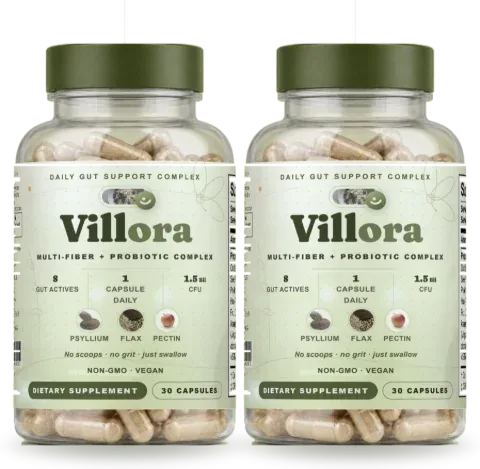
2 bottles
$69per bottle
- $138 total · 60 capsules
- $9.99 shipping
- $2.47 a day with shipping
- Good for trying the routine first
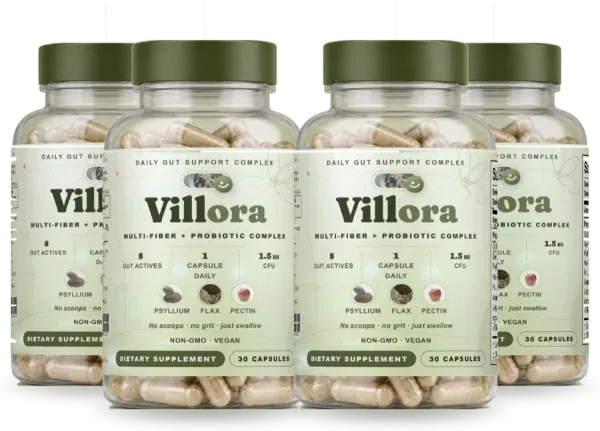
4 bottles
$59per bottle
- $236 total · 120 capsules
- Free US shipping
- about $1.97 a day
- Two digital guides included (sales page)
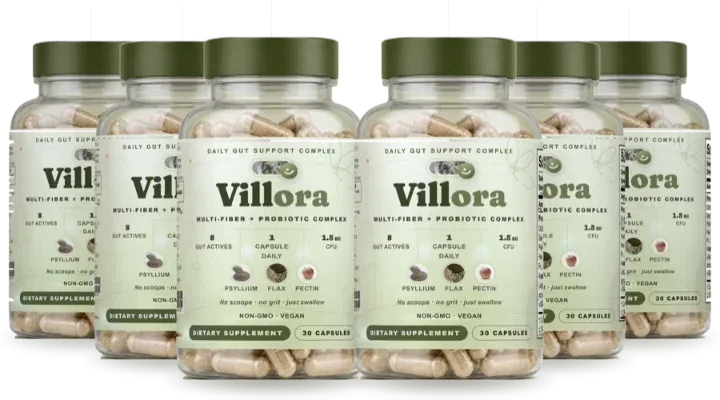
6 bottles
$49per bottle
- $294 total · 180 capsules
- Free US shipping
- about $1.63 a day
- Two digital guides included (sales page)
60-day money-back guarantee from the purchase date, per the sales page. Return the bottles, even empty, with tracking. Buyer pays return shipping. Questions: +1 (302) 200-3480 or [email protected].

Order links go to the official checkout through our checkout guide rules: check the address bar, the total and the shipping line before you pay. Tree-nut allergy? Do not order: the blend lists black walnut hull.
Questions people ask
Is the plum in Villora the same plum used for prunes?
The label lists Prunus domestica, which is the plum species commonly dried into prunes.1 The label does not say whether the powder was made from fresh or dried fruit. We only report the species and plant part as printed.
How many milligrams of plum powder does a Villora capsule contain?
The amount is not disclosed. Plum powder is part of a 695 mg proprietary blend, and the panel gives no per-ingredient milligrams.1 It is listed seventh of eight, so it is one of the smaller items by weight.
Does Villora plum powder count as a serving of fruit?
No. A serving of fruit is a food portion measured in grams, while the plum in Villora is a small share of a 695 mg blend. Fruit, vegetables and whole grains remain the main everyday sources of fiber.4
Why would plum powder be listed so close to the end of the Villora blend?
Items in a proprietary blend are listed in descending order of weight.2 Being seventh means plum weighs the same as or less than each of the six items above it. The label does not explain why the maker chose that amount.
Can I take Villora if I am sensitive to stone fruits?
Ask your doctor or allergist before taking it. The label lists plum fruit powder, and the product also contains black walnut hull, so anyone with a tree-nut allergy should not take it. Bring the label to your appointment so your clinician can see every item.
Sources for this page
- Villora bottle front label and Supplement Facts panel (photographed on this site)
- FDA — Dietary Supplement Labeling Guide
- MedlinePlus — High-fiber foods
- MedlinePlus — Dietary Fiber
- NIDDK — Eating, Diet & Nutrition for Constipation
- FDA — Dietary Supplements
- Dietary Guidelines for Americans
- FDA eCFR 21 CFR 201.319 — water-soluble gums warning
- FDA — MedWatch adverse event reporting